REVIEW · OSLO
Best of Oslo Guided Walking Tour
Book on Viator →Operated by Vox City International Ltd · Bookable on Viator
Two hours, and Oslo makes sense fast. This guided walking tour strings together Royal Palace, Oslo Cathedral (Domkirka), the Opera House, and Akershus Fortress with stories from a live English guide. I especially like the way the guide turns big monuments into real-life context, so you walk away knowing what you’re looking at.
Second, I like the built-in Vox City audio option: you can scan the QR code on your voucher and keep exploring after the tour with self-guided stops. One consideration: it’s mostly outdoor walking in central Oslo, so you’ll want layers and good weather—also, entry to sights is not included, so some stops are view-and-photo stops.
In This Review
- Key things to know before you go
- Oslo’s 2-hour best-of route: where this tour really shines
- Price and value: what $38.70 buys in practice
- Meet at University Aula: finding the start without stress
- The walk through Oslo’s power: University halls, theatre stories, Royal Palace
- Karl Johans gate to the Storting: civic Oslo in full view
- Nobel Peace Center, the hotel tradition, and the artsy-everyday blend
- Domkirka and the Opera House: Oslo’s landmarks that demand eye contact
- Oldest districts, cobblestones, and Market Square: the “slow down” part
- Akershus Fortress and its changing roles: from royal residence to military base
- City Hall, National Mall of Norway, and the “peace and politics” meeting point
- Waterfront views and Tjuvholmen: Oslo’s transformation story in motion
- How the Vox City audio app extends your day (without extra planning)
- A few practical tips so the walk feels easy
- Should you book this Oslo guided walking tour?
- FAQ
- How long is the Best of Oslo Guided Walking Tour?
- Is the live guide available in English?
- Where does the tour start and end?
- Is entry to attractions included?
- Do I get an audio guide or app with this tour?
- What happens if the weather is poor?
Key things to know before you go
- Live guide is English-only, while the Vox City app provides multilingual audio commentary.
- Two hours in the center of Oslo works great as a first-day orientation.
- Photo stops are real stops: you’ll get time to look up at big buildings like the Opera House and Domkirka.
- You’ll cover a lot of ground, so wear shoes you trust on sidewalks and cobblestones.
- The route mixes power and everyday life: Royal Guard, Parliament, markets, shopping streets, and the waterfront.
- It ends where it starts, so you don’t have to re-orient yourself at the end of your walking day.
Oslo’s 2-hour best-of route: where this tour really shines

If you’re arriving in Oslo with limited time, this tour is a smart way to get oriented without guesswork. You’ll hit the city center landmarks that show up on postcards, but the guide focuses on what they mean—royal tradition, civic life, and Norway’s cultural scene.
The tour is also a good “conversation starter.” Many guides on this route have a knack for making history feel like something you can picture, not a list of dates. Names like Tetiana, Anastasia, and Ihor come up with guests for a reason: they tend to keep the walk lively, answer questions, and explain what locals care about—today, not just long ago.
You can also read our reviews of more walking tours in Oslo



Price and value: what $38.70 buys in practice
At about $38.70 per person for roughly two hours, you’re paying for two things: a live guide and a self-guided audio add-on. That’s usually where walking tours earn their keep. You’re not just buying sightseeing—you’re buying the “why” behind it, plus an easy way to revisit key areas later.
Also, this tour is timed for efficiency. It’s offered in English, it starts in the heart of the city, and it returns you to the meeting point. If you’re trying to make the most of a short Oslo stay, that structure has value.
Meet at University Aula: finding the start without stress
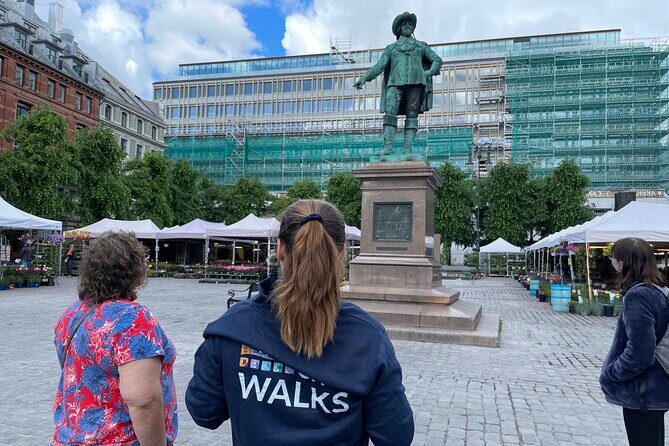
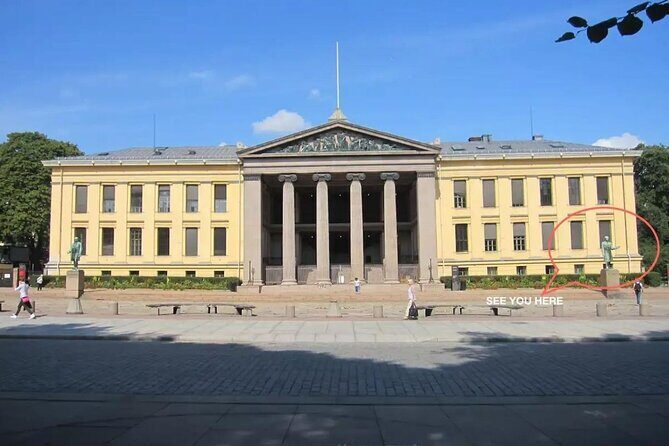
You start at University Square, near the Faculty of Law building entrance at University Aula, Karl Johan Str. 47. The meeting point marker is the statue of P.A. Munch by the entrance.
Plan to arrive about 5 minutes early if you can. The walk is only around two hours, and you don’t want to lose momentum waiting around. A simple move: have your voucher ready on your phone in case you need directions or to scan the QR code for the audio app.
This tour uses a mobile ticket, and the self-guided audio portion is accessed by scanning the QR code from your voucher to download the Vox City app prior to arrival.
The walk through Oslo’s power: University halls, theatre stories, Royal Palace

The tour begins in central Oslo, where you’ll first see the University of Oslo’s earliest building—a historical and ceremonial hall right in the middle of town. Even if you’re not a campus person, this stop shows how Oslo grew around institutions, not off to the side.
From there, you’ll hear about Norway’s theatre tradition near one of Oslo’s beloved landmarks. It’s a nice tempo shift: you’re going from education and ceremony to culture, and it helps explain why Oslo’s arts scene matters in everyday life.
Then comes the highlight for many people: the Royal Palace, guarded by His Majesty The King’s Guard. You’ll walk up to the palace with time to take photos and look at the scene from street level—an easy way to catch the royal atmosphere without needing to plan a separate visit.
Karl Johans gate to the Storting: civic Oslo in full view
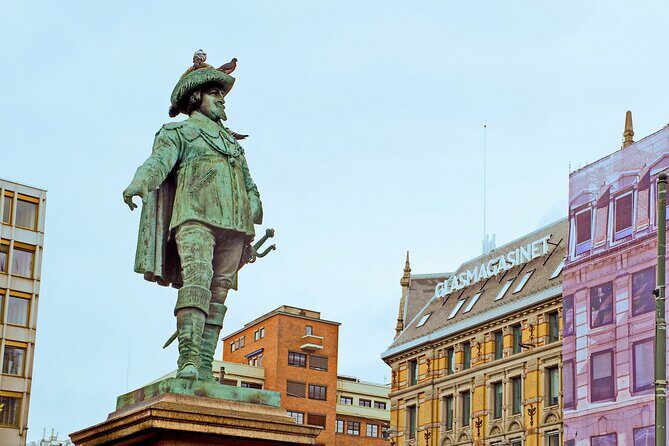
Next you’ll stroll along Karl Johans gate, the main street packed with shops, restaurants, and city energy. You’ll also see the statue of King Karl XIV Johan, a reminder that Norway’s story includes monarchy, not just modern politics.
As you continue, you’ll pass the Norwegian Parliament building (the Storting), where lawmakers have assembled since 1866. This is one of those moments where the architecture becomes part of the lesson. It’s not just a building to look at; it’s a symbol of how governance has shaped modern Norway.
This stretch also sets you up for the more modern Oslo themes later. You’re seeing the spine of the city: where authority, public life, and daily movement meet.
You can also read our reviews of more guided tours in Oslo






Nobel Peace Center, the hotel tradition, and the artsy-everyday blend
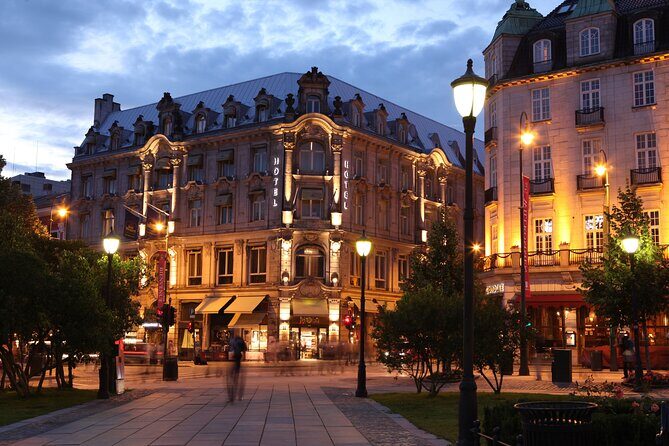
One of the most interesting stops on this route is the Nobel connection area. The tour is designed to include the Nobel Peace Center, and you’ll also pass the iconic white granite 5-star hotel where Nobel Prize winners stay each year. That detail matters because Oslo treats Nobel recognition as part of its city identity, not a one-time headline.
After that, the walk shifts to streets and indoor passages where Oslo’s character shows up in small things: historic red-brick halls with shops, arts and crafts, and cafés, followed by a shopping center where you can mix designer brands with local finds and gifts.
The value here is simple: you don’t just tour buildings. You learn where people actually browse, meet, and spend time.
Domkirka and the Opera House: Oslo’s landmarks that demand eye contact
Then you’ll hit Domkirka, also called Oslo Cathedral, the main church for the Diocese of Oslo and the seat of the Bishop of Oslo. It’s a powerful stop because you get to see how Oslo’s spiritual life and civic life coexist in one central footprint.
After Domkirka, look for the tour’s architectural photo moment: the iconic Opera House and Ballet building. You’ll pause for a snap of a structure that’s instantly recognizable from photos—and it’s even more impressive in person when you can judge scale and materials up close.
If you like architecture, this is where the tour starts feeling less like a checklist and more like a guided gallery walk. If you don’t, you’ll still appreciate how the city signals its priorities through big public buildings.
Oldest districts, cobblestones, and Market Square: the “slow down” part
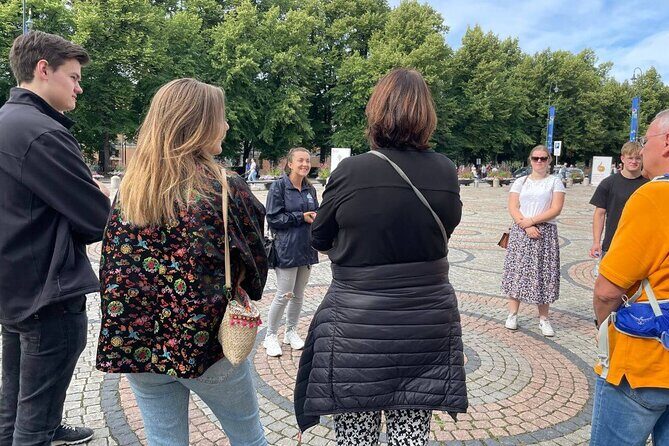
As the route continues, you’ll wander into the city’s oldest district, described as a charming area with cobblestone streets and impressive architecture. This is the part of the tour where the pace naturally feels different. Cobblestones make you slow down, and that’s good. It gives you a chance to absorb street scale—how buildings relate to people.
Next you’ll reach the historic market square, where you can find some of the city’s oldest buildings. Even if you don’t plan to shop, this stop helps you understand Oslo as a working city, not only a ceremonial one.
Tip: if it’s windy or chilly, this is where you’ll feel it the most. Bring a layer you can pull on quickly.
Akershus Fortress and its changing roles: from royal residence to military base
The tour then moves to a fortress with a complicated past. You’ll pass the stronghold that has served as a royal residence, prison, military base, and more.
That combination of roles is exactly why Akershus-style stops work on a guided walk. A fortress isn’t interesting because it looks old—it’s interesting because it was useful to different eras in different ways. With the guide’s explanation, it becomes easier to picture why walls, gates, and placement mattered.
This portion is also great for photos, because you’ll be looking at a mix of defensive architecture and waterfront-level views nearby as the route continues.
City Hall, National Mall of Norway, and the “peace and politics” meeting point
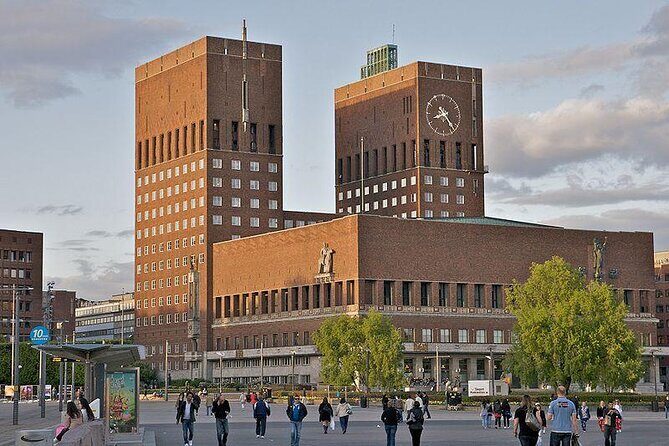
Next up: Oslo City Hall, where the exterior artwork reflects the city’s cultural heritage. Even viewed from outside, it’s a reminder that public art in Oslo isn’t only decoration—it’s messaging.
Then you’ll experience National Mall of Norway, a center built in 2005 focused on peace and understanding around the world. The tour also frames it as a place where Norwegians express political views and give feedback to the government. That blend—values in one space, civic participation in another—makes this more than a stop for photos.
It’s a good segment if you like connecting the dots between culture, policy, and public space.
Waterfront views and Tjuvholmen: Oslo’s transformation story in motion
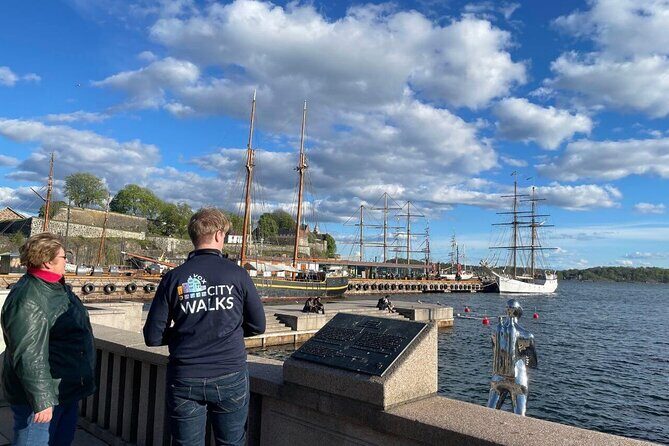
As you head toward the waterfront, you’ll get skyline views of the city and a chance for those wide-angle photos where Oslo looks especially clean and modern.
Then the tour reaches Tjuvholmen, a neighborhood that used to be a historic fishing and shipbuilding community. The key detail here is transformation: it has changed dramatically, adding new restaurants, shops, and art galleries.
This is where the tour ends up feeling current. You’re not only learning what Oslo was; you’re seeing the city’s evolution while you walk.
The final step is simple: the experience ends back at the meeting point at University Square, so you can plan your next stop without re-checking where you are.
How the Vox City audio app extends your day (without extra planning)
Don’t treat the tour as a one-and-done activity. You’ll get a Vox City sightseeing app with self-guided audio tours. Before you arrive, scan the QR code on your voucher to download it.
One useful feature: the app offers multilingual commentary in English, Spanish, German, French, and Italian. Even if your live guide is English-only, the audio option gives you flexibility later—especially if someone in your group prefers another language for independent exploring.
In practice, it works like a memory tool. After the walk, you can return to a stop you liked, replay the narration, and look again with better context.
A few practical tips so the walk feels easy
- Dress for wind and weather. The tour requires good weather, and it’s outdoors for much of the route.
- Bring comfortable shoes, especially for cobblestone sections.
- Plan to take photos, but don’t get stuck behind your phone. The best moments are often when the guide is explaining what you’re seeing.
- If you care about specific attractions you want to enter, plan that separately. Entry to attractions is not included.
- If you’re prone to being late, start moving early. The meeting point is specific: University Aula by the Faculty of Law entrance near the P.A. Munch statue.
Should you book this Oslo guided walking tour?
Book it if you want a high-efficiency introduction to central Oslo. It’s a strong choice for first-timers, time-crunched visitors, and anyone who likes understanding how monuments connect to real city life. The live guide experience can make the difference—many guides like Tetiana, Anastasia, and Ihor are repeatedly praised for energy and clear explanations.
Skip it (or pair it with other plans) if you’re hoping to pay once and enter lots of attractions. Since entry is not included, you’ll need to add tickets for museums or tours you care about. Also, if you don’t like walking outdoors for extended stretches, consider a more indoor-focused plan.
FAQ
How long is the Best of Oslo Guided Walking Tour?
The tour lasts about 2 hours.
Is the live guide available in English?
Yes. The live guide provides English-only commentary.
Where does the tour start and end?
It starts at University Square near the University Aula / Faculty of Law entrance (Karl Johan Str. 47), by the statue of P.A. Munch, and ends back at the same meeting point.
Is entry to attractions included?
No. Entry to attractions is not included.
Do I get an audio guide or app with this tour?
Yes. You get the Vox City sightseeing app, with a self-guided audio walking tour of Oslo. You access it by scanning the QR code on your voucher, and it includes multilingual commentary in English, Spanish, German, French, and Italian.
What happens if the weather is poor?
The experience requires good weather. If it’s canceled due to poor weather, you’ll be offered a different date or a full refund.
Would you like me to tailor a 1-day Oslo plan around this tour—coffee stops, museum ideas, and how to schedule Nobel Peace Center and the waterfront afterward?