REVIEW · OSLO
Central Oslo Guided Walking Tour with Local Guide
Book on Viator →Operated by NORDIC FREEDOM TOURS · Bookable on Viator
Two hours gives you real bearings in central Oslo, fast. This guided walk strings together the city’s must-see landmarks in a tight route, and you’ll learn how modern Oslo grew from medieval roots and royal power. I love the hands-on orientation feel: you cover the core sights you’d otherwise scatter across several days. I also love the guide style—stories with a sense of humor, and explanations that don’t feel like a lecture.
The main thing to consider is the walking. You’ll move between many blocks over about two hours, so if you have mobility limits, you’ll want to plan slower pace and wear comfortable shoes.
In This Review
- Key things that make this Oslo walking tour worth your time
- Central Oslo in 2 hours: what you’ll cover on foot
- Starting at TigerJernbanetorget: Tigeren and why Oslo is the Tiger City
- Oslo Opera House waterfront views: modern architecture without the ticket hassle
- Rådhusgata to Oslo City Hall: old street power and the Nobel link
- Akershus Fortress to Oslo Cathedral: medieval protection to Baroque style
- Karl Johans Gate and the Storting: walking Oslo’s main axis of authority
- Aker Brygge to the Royal Palace finish: waterfront energy and a strong ending view
- Guides, group size, and hearing the stories in the street
- Price and value: is $16.94 a good deal for central Oslo?
- How to use this tour on your trip day
- Quick practical notes: what’s included and what you should expect
- Should you book this Central Oslo guided walking tour?
- FAQ
- How long is the Central Oslo guided walking tour?
- What’s the price per person?
- Where do I meet the guide?
- Where does the tour end?
- Is the tour offered in English?
- Are we going inside any buildings?
Key things that make this Oslo walking tour worth your time
- TigerJernbanetorget to the Royal Palace: a logical sightseeing line through the heart of town
- Landmark variety: opera, fortress, churches, parliament, and waterfront all in one go
- Great guide energy: people are specifically praised by name (Suzanne, Alexia, Marta, Daniel, Kamil, and Camille)
- Good group handling: groups up to 27, with a guide keeping everyone together
- No inside-building visits: you get the sights from the outside and learn the context on the move
- Value pricing: $16.94 for a 2-hour, guided overview of central Oslo
Central Oslo in 2 hours: what you’ll cover on foot
This tour is built for a first pass through Oslo. In about two hours, you’ll get a compact overview of the city center: key architecture, big institutions, and the waterfront areas people point to when they describe Oslo.
What makes the route practical is the flow. You start near the central rail area, move toward the waterfront and opera district, then work your way through the government and main-street area, finishing at one of Oslo’s most photogenic spots—the square in front of the Royal Palace. Even if you only have a day or two, you’ll come away knowing where things are.
One more real-world detail: the tour is offered in English and you get a mobile ticket. That sounds minor, but it reduces friction when you’re figuring out transit, weather, and timing.
You can also read our reviews of more walking tours in Oslo



Starting at TigerJernbanetorget: Tigeren and why Oslo is the Tiger City
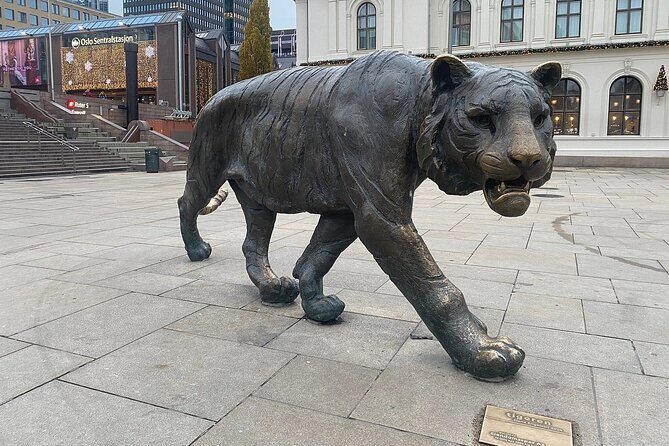
Your first stop is the iconic Tiger Sculpture (Tigeren) at Jernbanetorget. It’s positioned at the kind of hub travelers naturally pass through, which means you get oriented immediately—big central square, easy meeting point, and a famous landmark right away.
This tiger isn’t just a photo prop. The sculpture was erected in 2000 to commemorate Oslo’s millennium, and it’s tied to the city nickname, Tiger City. That nickname pops up again and again in Oslo’s storytelling, and having it early helps you understand the tone of the place: proud, modern, and still rooted in identity.
If you like symbolism explained simply, this opening works. It gives you a label for the city before you start seeing the buildings and waterfront that shaped it.
Oslo Opera House waterfront views: modern architecture without the ticket hassle
Next you’ll head toward the Oslo Opera House, completed in 2008. This building is one of those skyline landmarks you can spot even if you’re not sure what it is. The tour focuses on what you can see from the outside and around the waterfront setting, which makes it a low-stress stop.
The Opera House is known for its contemporary design and its placement right on the water. Even without going inside, it’s a useful stop because it shows how Oslo balances big institutions with a very public waterfront feel. It also sets up the rest of the tour: government buildings and historic fortresses are coming, so the contrast is part of the payoff.
Practical note: the tour does not include visits inside buildings. So plan to enjoy the architecture from outside angles rather than expecting a guided interior visit.
Rådhusgata to Oslo City Hall: old street power and the Nobel link
From there, the route moves through Rådhusgata, a historic street dating back to the 1620s. That matters because Oslo’s center isn’t just about one era. You’re walking a corridor where older urban planning shows up in the street layout and how the city grew around its civic buildings.
Then you reach Oslo City Hall, constructed from 1931 to 1950. This is one of the city’s most recognizable administrative structures, tied to Norwegian social and cultural ideals. A key detail you’ll hear on the walk is that the Nobel Peace Prize ceremony is held there annually—so you’re not just looking at a building, you’re looking at a place connected to global history.
What I like about this section is how it turns architecture into context. You’re learning why institutions sit where they do, and you’re seeing the city’s “power map” without needing to study it on your own.
Akershus Fortress to Oslo Cathedral: medieval protection to Baroque style
Now the tour changes gears. You’ll visit Akershus Fortress, built in the late 13th century (around 1299) to protect Oslo from invasions. It later served as a military base and prison, and today it functions as a museum and historical site.
Even though the tour doesn’t include interior building visits, this stop is still worth it. Fortress walls and defensive layout are easier to grasp in person, and the location helps you understand why Oslo built where it built. If you want a quick mental timeline—defense, authority, and later public memory—this is the moment it clicks.
After the fortress, you’ll see Oslo Cathedral (originally constructed in 1697). It’s known for Baroque architecture, and renovations over time—especially in the 20th century—are part of its story. Cathedrals can feel like “just a church” if someone doesn’t explain what changed and when. Here, the point is to help you notice the building as an evolving piece of Oslo’s identity, not a museum case.
If you’re the kind of traveler who enjoys history that you can point to, this pairing—fortress plus cathedral—gives you two very different layers of the city’s past in one walking segment.
You can also read our reviews of more guided tours in Oslo






Karl Johans Gate and the Storting: walking Oslo’s main axis of authority
Next you’ll move onto Karl Johans Gate, Oslo’s main street. It stretches from the Royal Palace to Oslo Central Station and has long been the spine of central Oslo. You’ll see historic buildings, shopping and dining, and cultural sites along the way—basically the everyday version of the city’s image.
This is a smart stop for two reasons. First, it lets you connect the “big landmarks” to the streets where people actually live and walk. Second, it gives you a path you can reuse later, since it’s one of the most useful streets to know for self-guided exploring.
Then the walk reaches the Storting building, the seat of the Norwegian Parliament. Construction ran from 1861 to 1866, and the building is an obvious symbol of Norway’s legislative authority. When your guide explains what parliament represents, it changes the way you see the facade. It stops being scenery and becomes a civic statement.
If you’re curious about how countries organize power and how it shows up in architecture, this section delivers that in a simple, street-level way.
Aker Brygge to the Royal Palace finish: waterfront energy and a strong ending view
After the government corridor, you shift toward Aker Brygge, a shopping, entertainment, and dining district on the waterfront. What’s helpful here is the origin story: it began as a shipyard established in 1854, then transformed into its modern form in the 1980s.
That detail matters because it explains why the waterfront feels both old and newly repurposed. You’re not just seeing a trendy area; you’re seeing industrial Oslo turned into a public space. It’s a reminder that many of Europe’s best neighborhoods started as something else entirely.
The tour then finishes at the square in front of the Royal Palace (Det Kongelige Slott), where you can enjoy the view of a major landmark in Oslo’s center. Finishing here is a nice trick. It caps the tour with a “you’re here” anchor—useful for planning the rest of your day and easy to find again.
Guides, group size, and hearing the stories in the street
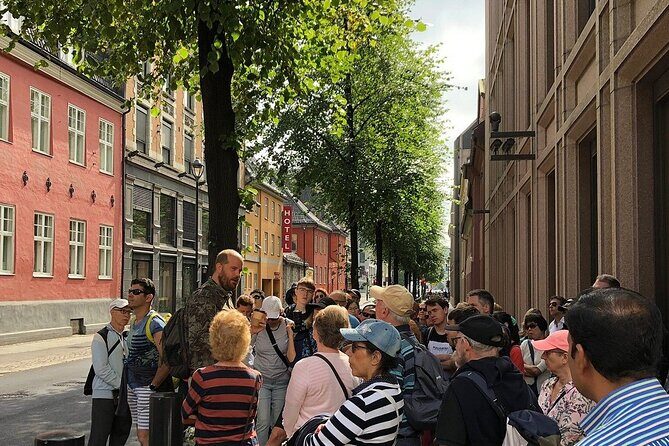
This tour caps at 27 travelers, which is large enough that you’ll want your guide to manage the group actively. The good news: the feedback emphasizes that guides keep people together and maintain a conversational pace.
You’ll also see a pattern in the praise: guides are described as friendly, humorous, and able to answer questions. Names that come up include Suzanne, Alexia, Marta, Daniel, Kamil, Camille, and Martha. That’s a useful signal. It suggests you’re not just buying a route—you’re buying a person who can connect the dots.
One listening caveat shows up in the notes too: on rainy or noisy days, some people find it harder to hear if the speaking pace is fast or the microphone setup isn’t perfect. If you’re sensitive to audio, I’d recommend choosing a position close to the guide and bringing a hood or light rain layer so you’re not distracted by weather.
Price and value: is $16.94 a good deal for central Oslo?
At $16.94 per person for about two hours, the value is strong if your goal is orientation and context. This isn’t an all-day ticket to one museum. You’re getting a curated walk through multiple top-tier Oslo landmarks—Tiger Sculpture, Opera House, City Hall, Akershus Fortress, the Cathedral, Karl Johans Gate, the Storting, Aker Brygge—plus the explanations that make those stops click.
The real value isn’t any single landmark. It’s the sequencing. You see the city’s story unfold: identity (Tiger City), modern culture (Opera House), civic authority (City Hall and parliament), and historical defense and worship (Akershus and Cathedral). You can’t easily “DIY” that kind of narrative quickly without spending time researching each stop.
The tradeoff is the tour doesn’t include visits inside buildings, so you’ll be outside for everything. If you’re looking for an interior-heavy day, this won’t fully match that. But if you want a fast first-day tour to set your priorities, the price-to-time ratio makes sense.
How to use this tour on your trip day
I like doing a city overview walk early because it changes your decisions later. After a route like this, you’ll know:
- which landmarks you’re most drawn to for a return visit
- which streets make sense for self-guided wandering (Karl Johans Gate is the big one)
- which areas feel like “wander zones” (Aker Brygge is great for that kind of plan)
Also, you’ll learn what to ask next. On this kind of walk, the best questions are usually simple: what changed here, why here, and how does that connect to modern Oslo? A good guide can help you turn sightseeing into smarter planning.
If it’s raining, don’t automatically skip the idea. One of the notes in the feedback is that the tour can still work in bad weather with the guide’s pacing. Just bring layers and keep your footing—wet cobblestones and slick steps are no joke.
Quick practical notes: what’s included and what you should expect
Included: a knowledgeable local guide for the group.
Not included: any interior visits inside buildings. So think of it as a guided walk for seeing exteriors, learning context, and getting your bearings.
You’ll also get a mobile ticket, and the tour is offered in English. Service animals are allowed, and the meeting point is TigerJernbanetorget in central Oslo. The tour ends at Royal Palace (Slottsplassen 1), right where you can continue exploring.
Should you book this Central Oslo guided walking tour?
Book it if you want a smart first-day orientation through the most walkable center landmarks, plus stories that explain what you’re looking at. The combination of strong reviews, guide humor, and a tight two-hour pace makes it a high-probability win.
Skip it if you’re hoping for a mostly interior, ticketed highlights day. This is a “see it from the street and understand it” experience. Also, if you have limited walking stamina, plan carefully—this route covers multiple city blocks.
If your priority is to get your bearings in central Oslo without wasting half a day figuring out logistics, this is one of the easier ways to do it.
FAQ
How long is the Central Oslo guided walking tour?
It lasts about 2 hours.
What’s the price per person?
The price is $16.94 per person.
Where do I meet the guide?
The tour starts at TigerJernbanetorget, 0154 Oslo, Norway.
Where does the tour end?
It ends in front of the Royal Palace (Det Kongelige Slott), Slottsplassen 1, 0010 Oslo, Norway.
Is the tour offered in English?
Yes, it’s offered in English and you receive a mobile ticket.
Are we going inside any buildings?
No. The tour does not include visits inside any buildings.