REVIEW · OSLO
Unknown war. Oslo and Norway during 1940-45
Book on Viator →Operated by Oslo Photo Tour · Bookable on Viator
Oslo turns different when you track WWII on foot. This 2.5-hour private walk maps the story of the German occupation onto the city center, using exact-place historic photos. You’ll move between big landmarks and small street corners, all tied to what changed from 1940 to 1945.
What I like most is the way historic photographs are used on location, so the past sits right in front of you. I also love the focus on everyday life, not just the headlines, with room for your questions and a flexible route for your group.
One thing to consider: it’s a walking tour built for good weather. If rain shows up, you’ll want an umbrella and you may feel the pace more than on a ride-based tour.
In This Review
- Quick hits you’ll feel right away
- Entering Oslo’s WWII story one stop at a time
- Meeting at Karl Johan-monumentet: built for a 2.5-hour pace
- Royal Palace stop: power, symbolism, and what the city hides
- Karl Johans Gate and the Norwegian Parliament: the occupation story in civic space
- Stortorvet Kebab market square: WWII facts without forgetting public life
- University of Oslo (Faculty of Law) and University Square: rules, language, and questions
- Nationaltheatret and Gunnar Sønsteby monument: resistance story in public view
- Akershus Castle and Fortress: the walk’s finale near Norway’s Resistance Museum
- Why Rami’s historic photos make the tour stick
- Price and value for a private group of up to five
- Practical tips so the walk stays fun, not just educational
- Should you book this WWII Oslo walking tour?
- FAQ
- What’s the duration of the Oslo WWII walking tour?
- How many people can be in the group?
- Where does the tour start and end?
- Are admission tickets included for the stops?
- Is the tour offered in English?
- What if the weather is bad?
Quick hits you’ll feel right away
- Street-level WWII photos matched to where you’re standing
- Private, small group setup (up to 5) with an itinerary shaped around you
- Royal Palace to Akershus in one logical city loop
- Balanced, fact-first storytelling covering occupation and resistance
- Easy pairing with Norway’s Resistance Museum since the tour ends nearby
- Very high satisfaction (5-star rating across 74 reviews, with 100% recommendation)
Entering Oslo’s WWII story one stop at a time
If you’ve ever looked at a war photo and thought, okay, but where is that today, this tour gives you an answer. You walk through Oslo’s main center while your guide points out places where WWII left marks, even when the buildings look normal.
What makes it work is the method: you’re not just hearing dates. You’re watching history take shape as you connect landmark names to the human reality of occupation. The result is a city walk that feels specific, not generic.
Also, it helps that it’s a private tour for your group (up to five). That matters because WWII questions get personal fast. You can ask for more context, slow down on a topic, or skip something you’re not interested in.
You can also read our reviews of more tours and experiences in Oslo.



Meeting at Karl Johan-monumentet: built for a 2.5-hour pace

You start at the Karl Johan-monumentet in Sentrum. From there, you cover the historical core at a comfortable walking tempo for about 2 hours 30 minutes.
The stops are short, roughly 10 minutes each, but the time adds up because you’re not just passing through. You’re learning what to notice while you’re there: architectural details, street placement, and how the occupation story moved through key civic areas and public life.
Because the tour is designed around a small group, you’re less likely to get that “tour bus lecture” feeling. The best part is that the guide can respond to how your group is doing, especially if you want more explanation or you’re fine with a faster rhythm.
Royal Palace stop: power, symbolism, and what the city hides
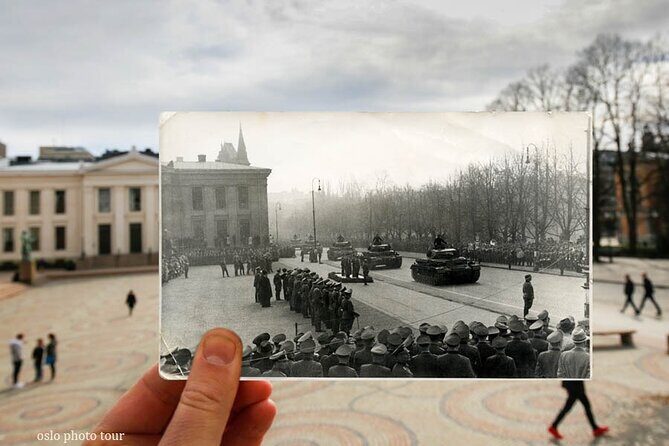
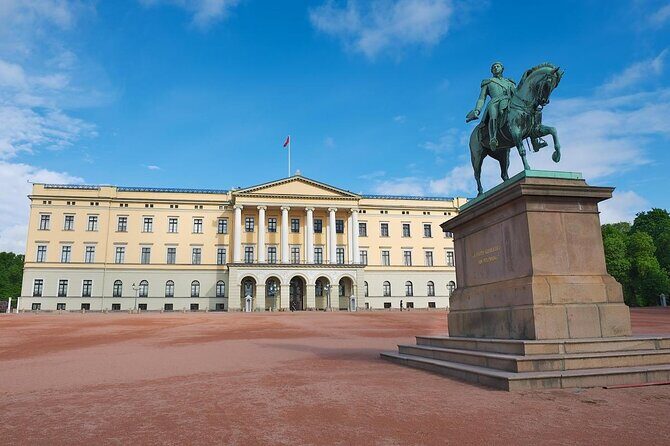
The first stop is the Royal Palace area. The admission ticket isn’t included, so you’re not counting on entering anything as part of the package. Instead, expect a viewpoint-style introduction—where the palace sits in the city and why that kind of place matters when power changes hands.
For WWII in Oslo, this is a smart opening. Starting with a landmark tied to Norway’s official identity gives you a baseline. Then your guide can explain how occupation affected the public mood and daily life around major institutions, even if you’re only seeing the exterior and surrounding streets.
Practical tip: take a moment at the edge of the site to orient yourself. When your guide points out references, you’ll understand them faster if you already know which direction you’re facing.
Karl Johans Gate and the Norwegian Parliament: the occupation story in civic space
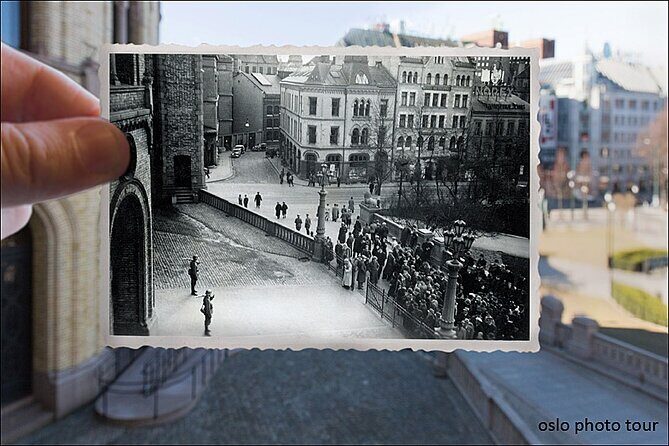
Next you head to Karl Johans Gate, then to the Norwegian Parliament. This is where the walk turns into a map of the political center, and it stays grounded in what you can see.
Karl Johans Gate is a key artery in the city. Your guide ties it to wartime-era activity and the visible traces of that era. Then the Parliament area adds another layer: how government spaces and civic authority played into the occupation reality.
What I found most useful about this section is the emphasis on the city layout. It’s one thing to read about control; it’s another to watch how the built environment channels attention and movement. You’ll start noticing how people would have experienced Oslo back then—through routes, gathering spots, and who had access.
Possible drawback: if you’re expecting the tour to be nonstop dramatic action, this part can feel more “interpretive.” That’s not bad, but it does mean you’ll get more from it if you like thinking about context and everyday impact.
Stortorvet Kebab market square: WWII facts without forgetting public life
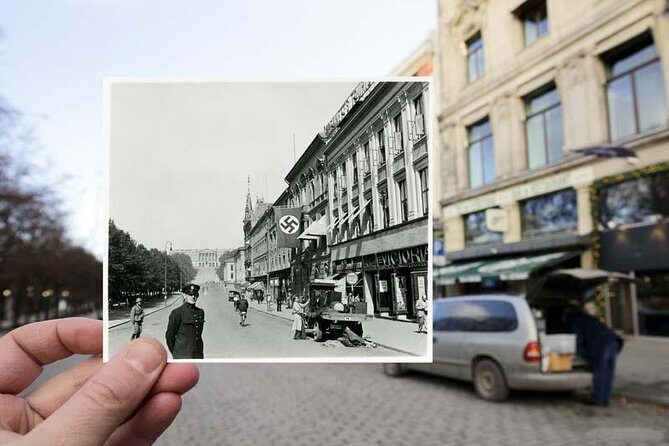
You stop at Stortorvet Kebab in the market square area. The big value here is contrast. After civic landmarks, you get a more human scale: a public square where ordinary life happens.
This is one of the stops that makes the WWII theme feel real. Occupation didn’t live only in parliaments and palaces. It shaped how people bought food, met friends, and moved through the day. A market square is where that kind of story lands best.
Also, the admission note here says ticket is free, which is helpful. You’re not burning time on paperwork or entry fees. You’re using the street scene as your classroom.
If you’re hungry, this is also the kind of stop where you might want to grab a snack afterward. The tour keeps moving, but you’ll be in a location that’s easy to continue exploring on your own after.



University of Oslo (Faculty of Law) and University Square: rules, language, and questions
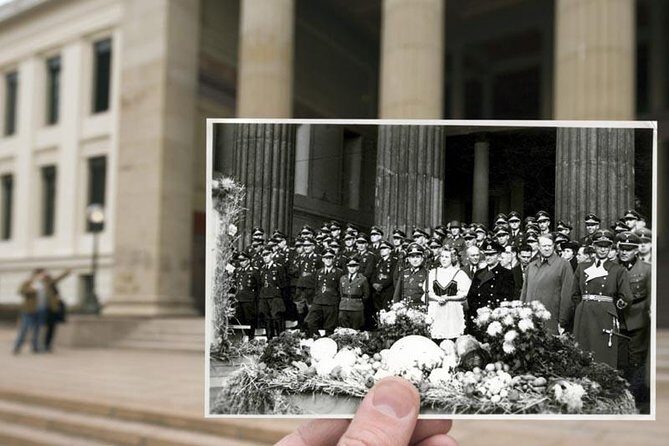
Next you reach University of Oslo at Faculty of Law, within University square. Again, the admission ticket is free here, so you can treat it as a calm, no-pressure stop.
This part works well if you enjoy learning how societies run on rules. Even if you don’t focus on legal history, the setting helps your guide connect occupation pressures to institutions that shape how people think, speak, and decide.
From the way the tour is described, the guide uses historic photos at the exact locations. In this area, that approach can be especially eye-opening because educational and legal spaces tend to look timeless. When a street-level photo shows how things looked years earlier, it cuts through that sense that everything always “looked the same.”
Good to know: one review noted a family had trouble following while walking, and the guide was flexible about clarifying and answering questions. So if English isn’t your first language (or you just like slower explanations), ask. Don’t wait.
Nationaltheatret and Gunnar Sønsteby monument: resistance story in public view
At Nationaltheatret, you also see the Gunnar Sønsteby monument. This stop is where the tour’s WWII focus shifts toward resistance and the courage behind it.
Even though admission isn’t included here, you’ll get the context by standing near a landmark tied to Norwegian identity and then connecting it to the resistance story your guide is building throughout the walk.
Gunnar Sønsteby is a name that carries weight in Norway’s WWII narrative. The fact that the monument is placed at a major public spot means you get the resistance story not as something locked inside a museum, but as part of the city’s everyday memory.
This section tends to hit hardest if you’re the type who likes stories with people, not just strategy. The guide’s approach—especially the use of wartime photos—turns this into more than a statue-and-a-name stop.
Akershus Castle and Fortress: the walk’s finale near Norway’s Resistance Museum
The tour ends at Akershus Fortress, near Norway’s Resistance Museum. This is a strong ending choice because the setting already feels historic, and it’s a natural bridge to deeper museum time if you want it.
You won’t need to rush right after the tour, since the finish point is close to the museum. The museum opening hours listed here are Monday through Thursday, 9:00 AM to 4:00 PM, for the date range shown (09/03/2019 – 12/08/2026). If your timing lands outside that window, you can still use the fortress area for a quiet wander.
The castle-and-fortress setting also changes the “shape” of the story you’ve been hearing. Earlier stops are mostly about civic and street life. Here, the symbolism gets heavier: borders, security, and the sense of a country under pressure.
The one consideration: this final segment is where your feet will feel it most, since you’ve been walking since the start. Bring comfortable shoes and plan a bit of downtime afterward.
Why Rami’s historic photos make the tour stick
A clear theme in the experience is the guide’s photo method. Rami brings a private collection of WWII photos, and he shows them in relation to the exact places you visit. That matching is what turns “history” into something you can picture.
One reason this works so well is that buildings often still exist. When you see a wartime photo of a street corner and then look up at the same setting today, the contrast creates a mental shortcut. You stop thinking in abstract time and start thinking in location.
The tour also aims for a balanced, fact-first approach. One review specifically praised the neutral presentation backed by facts, including nuance around collaboration and the resistance story. That’s important because WWII stories can get oversimplified fast. This walk tries to keep the focus on what happened and what it meant for real people.
Also worth noting: the guide comes across as passionate and engaging in the way he tells the story. The best sign of quality here is pacing: people can follow along, ask questions, and feel like they’re keeping up.
Price and value for a private group of up to five
The price is $307.50 per group, up to five people, for about 2 hours 30 minutes. That’s private, and it’s one guide handling your group only.
Here’s the real value math: if you fill a group of five, you’re effectively paying about $61.50 per person. If you’re just two people, you’re paying about $153.75 each. Either way, it’s usually a better deal for small groups than for solo travelers, simply because you spread the guide cost.
Is it worth it? If you care about WWII context and you like seeing how the occupation story connects street-level locations, yes. The photo-driven format and the flexibility for your interests add value that generic “big landmarks only” tours often miss.
Practical tips so the walk stays fun, not just educational
This is a weather-dependent walking tour. If rain is possible, plan like it is. One review even suggested bringing an umbrella, and I agree. A dry, comfortable experience helps you focus on details your guide points out.
A few more practical notes based on what’s explicitly provided:
- You’ll use a mobile ticket.
- The tour is offered in English.
- Service animals are allowed.
- Most travelers can participate, but wear shoes you’d wear for an active morning.
- Confirmation is received within 48 hours of booking, based on availability.
One small strategy: think of this as your “city lens” tour. Do a quick Oslo overview walk later if you want, but for WWII-focused understanding, this tour gives you the framework so other sites make more sense.
Should you book this WWII Oslo walking tour?
Book it if you want a WWII experience that stays rooted in real places. I especially recommend it if you’re visiting Oslo for a short time and you’d like a fast, city-center way to understand occupation and resistance without jumping between far-flung locations.
Skip it (or adjust expectations) if you only want famous sights with minimal context. This tour is built for historical interpretation, photos on the street, and discussion, not for a checklist photo session.
Also, it fits well with people who like asking questions. The guide’s flexibility is a big plus, whether you want to slow down on one topic or you need to respond to how your group is feeling that day.
If you’re the type who enjoys museums but also wants the story connected to the streets around you, the ending near Norway’s Resistance Museum makes this a clean pairing.
FAQ
What’s the duration of the Oslo WWII walking tour?
It runs for approximately 2 hours 30 minutes.
How many people can be in the group?
It’s a private tour for your group, with up to 5 people.
Where does the tour start and end?
You start at Karl Johan-monumentet in Sentrum, and you end at Akershus Fortress near Norway’s Resistance Museum.
Are admission tickets included for the stops?
Not always. The Royal Palace and Nationaltheatret note that admission tickets are not included. Other stops (like Stortorvet Kebab and the University of Oslo Faculty of Law area) are listed as free.
Is the tour offered in English?
Yes, the tour is offered in English.
What if the weather is bad?
The experience requires good weather. If it’s canceled due to poor weather, you’ll be offered a different date or a full refund.