REVIEW · OSLO
Oslo Viking Quest: Exploration Game and Tour
Book on Viator →Operated by Questo · Bookable on Viator
Oslo feels easier when it’s a game. I like the puzzle-driven format that keeps you actively scanning for details, and I like that it hits major sights like the Royal Palace and City Hall. The only real catch is that a few clues can feel hard to parse, so you’ll want patience if you’re visiting in bad weather.
This is a self-guided quest with a mobile access code, and you can start whenever you want. You can also pause and resume when you need a break for photos, coffee, or just to catch your breath.
Over about 1 hour 15 minutes (roughly), you’ll work through 11 interactive challenges that connect Oslo’s politics, art, and landmark architecture into one walkable storyline. The route is mostly central, ending near Akershus, where Norway’s Resistance Museum adds a sharper, more serious note.
In This Review
- Key things to know before you start in Oslo
- A game plan for central Oslo: how the quest flows
- Nobel Peace Center: puzzles that make you read, not just look
- Oslo City Hall: architecture history in the middle of the action
- Nils Sigurd Aas and the June Seventh Square: art you can spot
- Royal Palace and the University of Oslo: power and learning side by side
- Storting and Oslo Cathedral: Norway’s civic life on foot
- Akershus Fortress and Norway’s Resistance Museum: ending with weight
- Time, pacing, and weather: why 1 hour 15 minutes is a starting point
- Price and value: what $7.20 buys you (and what it doesn’t)
- Who this Oslo Viking Quest fits best
- Should you book Oslo Viking Quest?
- FAQ
- How long is Oslo Viking Quest?
- How much does the quest cost?
- Where does the quest start and end?
- What language is the quest offered in?
- Do I get a tour guide with this experience?
- How do I access the quest on the day?
- Can I pause and resume the game?
- Is there a fixed itinerary I have to follow?
- What if I need to cancel?
- What’s not included in the price?
Key things to know before you start in Oslo
- Mobile code quest: you don’t need to meet a guide; you start with your phone and follow the tasks.
- 11 puzzle challenges: the “why” is history, but the method is hands-on searching for answers.
- No fixed itinerary: you can move at your own pace and skip ahead if you want.
- Landmark mix: Royal Palace, City Hall, Storting, Oslo Cathedral, and Akershus are all part of the story.
- Short but flexible: the estimate is 1 hour 15 minutes, but side stops and time spent reading can stretch it out.
A game plan for central Oslo: how the quest flows
Oslo Viking Quest is built like a scavenger hunt, but with a Viking-themed storyline and actual Oslo context folded into each step. Instead of a normal lecture, you get short tasks that ask you to look around and find a specific answer—then that answer acts like your ticket to the next location.
You’ll move between key spots across downtown Oslo, using your mobile ticket/access code to access the quest. The experience is designed for independent pacing, so you can stop, resume, and keep going when it suits you. That flexibility matters in Oslo, where weather and crowds can change fast.
Also note what you don’t get: there’s no physical tour guide included. That’s part of the value—this is cheaper than a guided tour—but it also means you’re the driver of your own learning. If you like figuring things out yourself, you’ll click with this. If you want someone to constantly explain, you may prefer a traditional guided option.
Time-wise, the tour is listed at about 1 hour 15 minutes. In practice, I’d treat that as a baseline. The puzzle format slows you down in a good way, but it can also speed you up if you enjoy hunting details. Either way, it’s easy to build extra time if you want to linger near the sights.
A few more Oslo tours and experiences worth a look



Nobel Peace Center: puzzles that make you read, not just look
The quest starts at Rådhusgata 30B and initially takes you to the Nobel Peace Center. This stop is a smart opener because it sets the tone: it’s a showcase for the Nobel Peace Prize and the ideals behind it, where culture and politics meet through debate and reflection.
Here’s the mechanic: you’re challenged to look around to find an answer that lets you move on. The format nudges you to pay attention to what’s displayed and how the information is organized, rather than floating through on auto-pilot.
What I like about this start is the way it gives you a theme before you hit the government buildings. You’re not just collecting landmarks—you’re collecting ideas about peace, conflict, and decision-making. Even if you don’t plan to spend tons of time inside every exhibit, the quest structure pushes you to notice key messaging.
Practical tip: plan for a little extra time if you want to read carefully. Puzzle-style tasks reward the slower approach.
Oslo City Hall: architecture history in the middle of the action
Next up is Oslo City Hall. The building is the seat of the city council and municipal administration, and the current structure was built between 1931 and 1950, with an interruption during the Second World War.
Again, the quest asks you to look around to find the answer to your challenge. This is where the game does something useful: it turns what could be a quick exterior glance into an active search task. You’re training your eye to notice details tied to a timeline.
City Hall also works as a “bridge” stop. From here, you can naturally connect local government to national politics in your head, because the next part of the route goes toward the institutions of Norway’s central power.
If you’re the type who usually walks past big civic buildings without stopping, this step forces you to slow down for a reason.
Nils Sigurd Aas and the June Seventh Square: art you can spot
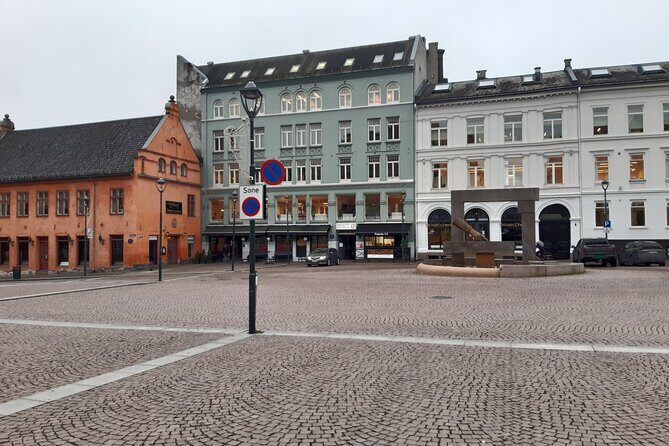
One of the most interesting steps is the stop tied to Nils Sigurd Aas (21 April 1933 – 10 February 2004). The quest uses him as a doorway into modern Norwegian sculpture.
The key detail included in the storyline is that he’s especially known for his statue of Haakon VII located in the June Seventh Square. He also designed coins for Norwegian currency, including 10-krone and 20-krone coins.
This kind of stop is great for two reasons. First, it’s specific—your brain remembers a person and a place. Second, it changes the feel of the route. After politics and buildings, you get something more personal: an artist whose work shows up in everyday life (coin design) and in a recognizable public landmark (the statue).
When you’re solving the challenge here, you’re likely looking for details you would otherwise miss. That’s the payoff of a puzzle quest: it rewards attention.
Royal Palace and the University of Oslo: power and learning side by side
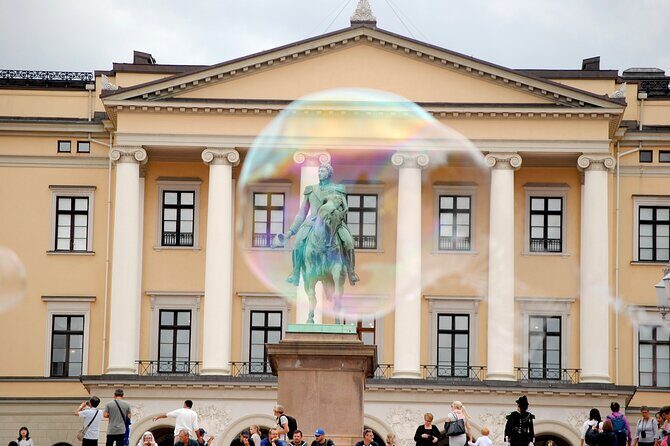
Then the route shifts to the Royal Palace in Oslo, built in the first half of the 19th century. It served as the Norwegian residence of King Charles III John, who was French-born and reigned as king of Norway and Sweden.
This part of the quest is essentially a historical prompt: instead of telling you a bunch at once, it asks you to look around and find a specific answer linked to the place’s story. That makes the palace feel less like a postcard and more like a chapter in a longer political arc.
Right after that, you’ll move toward the University of Oslo. It’s the oldest university in Norway, and it sits in Oslo. The quest notes that until 1939, it was named the Royal Frederick University—a small detail that helps you connect education to older state identity.
I like pairing these stops because they highlight two kinds of institutions: monarchy and academia. If you like seeing how societies organize power, knowledge, and tradition, this stretch will feel satisfying.
Practical note: the time you spend here is very much your choice. If you keep moving to the next clue, it stays brisk. If you want to read signage and linger, the quest still works because you can pause and resume.





Storting and Oslo Cathedral: Norway’s civic life on foot
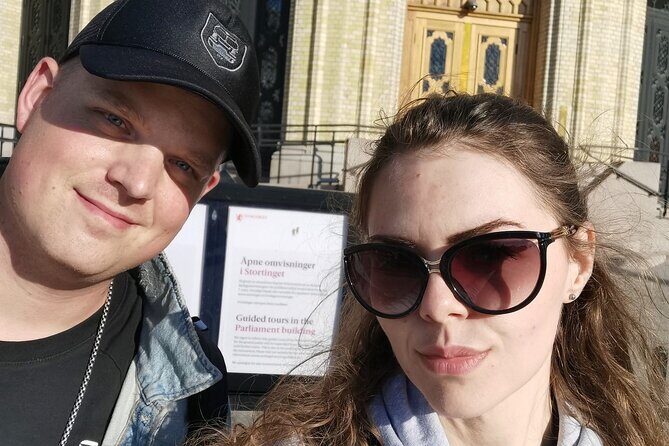
Next comes the Storting building, the seat of the Norwegian parliament, located at 22 Karl Johans gate in central Oslo. The building was taken into use on 5 March 1866 and designed by Swedish architect Emil Victor Langlet.
In a normal tour, this stop might be a short fact dump. In a puzzle quest, it becomes a scavenger hunt in a place tied to lawmaking. You’re not just absorbing dates—you’re connecting them to a real building you can stand in front of.
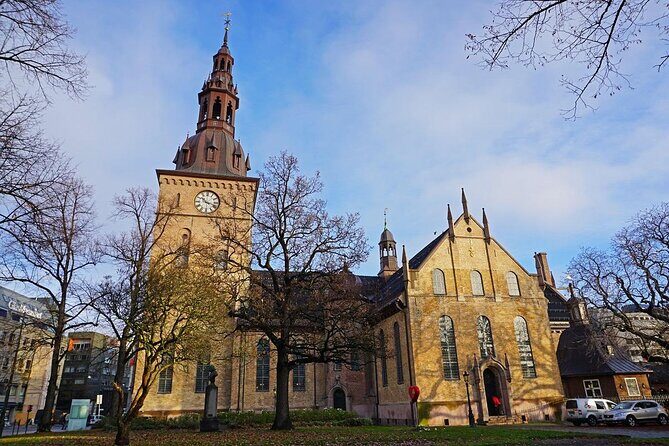
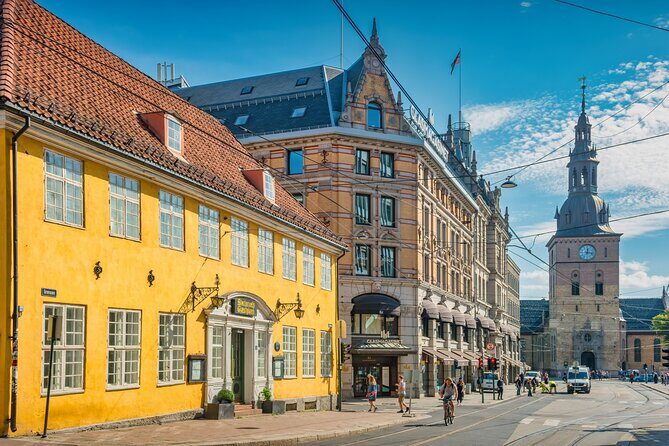
Then the quest heads to Oslo Cathedral, formerly Our Savior’s Church. The present building dates from 1694 to 1697 and it serves as the main church for the Church of Norway Diocese of Oslo and also the parish church for downtown Oslo. The storyline also notes that the Norwegian Royal Family and the Norwegian Government use the cathedral for public events.
This is a moment where the route can feel extra meaningful. You’re going from parliament to a central church that’s tied to national ceremonies. Even if you’re not attending an event, the quest pushes you to treat the space as more than a landmark.
If you’re sensitive to long indoor stops, keep it simple: focus on the outward signs and key features tied to the clue. You can always add extra time later if you want a deeper visit.
Akershus Fortress and Norway’s Resistance Museum: ending with weight
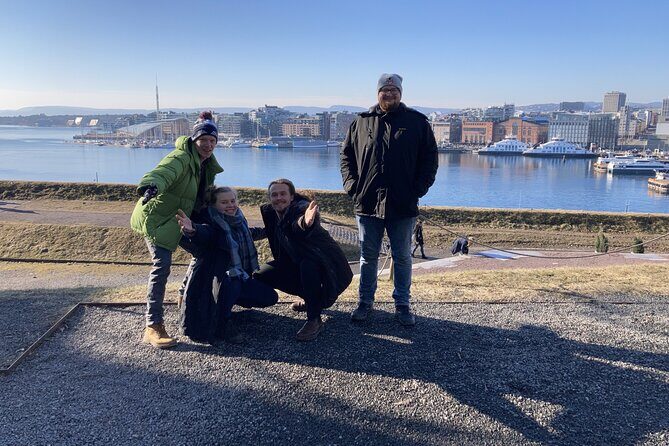
The final stretch lands near Akershus Fortress, ending at the Scandinavian Star Memorial, Akershusstranda. Akershus is described as a medieval castle in Oslo built to protect and provide a royal residence for the city.
This is a strong closing image. Fortress architecture tends to slow people down, and Akershus does the job of giving your walk a sense of arrival.
Then, the quest connects you to Norway’s Resistance Museum, also known as the Norwegian Home Front Museum, located at Akershus Fortress. The focus is Norwegian resistance during the occupation by Nazi Germany from 1940 to 1945, with displays of equipment, photos, and documents from the war years.
This pairing—medieval fortress plus WWII resistance—gives your whole quest a sharper emotional balance. Earlier stops covered governance, culture, and public institutions. Here, the theme turns toward courage, survival, and documentation. It’s not just a history stop; it’s a reminder that the stories of a country aren’t only made in parliament rooms.
If you want the quest to end on a thoughtful note, this is the part to slow down for. Even a focused look at a few displays can make the entire walk feel more grounded.
Time, pacing, and weather: why 1 hour 15 minutes is a starting point
The quest is listed at about 1 hour 15 minutes. But the way the challenges are structured means you’ll naturally spend time at each stop. If you’re the kind of person who reads signage and likes to solve things carefully, you may spend longer.
One more practical reality: puzzle quests have an extra variable—how quickly you interpret clues. If a hint is unclear, you might walk around twice. That’s normal. I’d build in buffer time, especially if you’re visiting when it’s cold or wet.
The good news is flexibility. You’re allowed to pause and resume anytime, and you can start when you want. That means you’re not stuck with a fixed group schedule if the weather changes.
My advice: give yourself a half-day window mindset. Even if you finish the quest in the estimated time, Oslo rewards extra wandering—so treat this as a smart base layer for your own exploration.
Price and value: what $7.20 buys you (and what it doesn’t)
At about $7.20 per person, this is priced like an inexpensive entry ticket into a structured sightseeing experience. You’re not paying for a guide; you’re paying for a mobile-driven route plus 11 interactive puzzle challenges and the storyline content.
That’s a great deal if you want:
- a fun way to learn landmark context without paying for private guide time
- a walkable route where you can control pace
- a way to keep groups engaged (the game structure tends to reduce the boredom factor)
The main trade-off is the lack of a physical tour guide. If you expect constant interpretation, you might find the experience needs your active participation. Still, the quest format is exactly what makes the low price possible.
Also, the experience lists group discounts, which can make it even better if you’re traveling with friends or family who enjoy solving things together.
Who this Oslo Viking Quest fits best
This one suits a particular kind of traveler: people who like to move, look closely, and learn by doing. You’ll probably enjoy it if you:
- prefer self-guided activities over sit-and-listen tours
- want a good overview of central Oslo in a short window
- like history facts, but also like a bit of play
It also makes sense for mixed groups. The puzzle steps tend to keep attention from drifting, because each stop gives a clear mini-goal.
If you’re traveling with someone who hates walking or hates games, the format might feel like extra work. For those cases, a classic guided tour may feel more comfortable.
Finally, it’s marked as suitable for most travelers, and service animals are allowed. It also runs near public transportation, which helps if you want to join partway through or build the walk around transit.
Should you book Oslo Viking Quest?
I’d book it if you want a cost-effective way to see major Oslo landmarks while staying mentally engaged. The combination of big civic sights (City Hall, Storting, cathedral), national narrative framing (Nobel Peace Center), and a heavier closing at Akershus gives you range without turning the day into a marathon.
Skip it or rethink it if you know you dislike puzzle-style navigation, or if you want a guide to explain every stop in depth. In this format, your attention is the main resource—and when you bring it, the payoff is better than a simple landmark checklist.
If you’re in central Oslo and want an action-oriented way to understand the city, this quest is a smart, low-cost choice.
FAQ
How long is Oslo Viking Quest?
It’s about 1 hour 15 minutes (approximately).
How much does the quest cost?
The price is listed as $7.20 per person.
Where does the quest start and end?
Start at Rådhusgata 30B, 0151 Oslo, Norway. End at the Scandinavian Star Memorial, Akershusstranda, 0150 Oslo, Norway.
What language is the quest offered in?
The quest is offered in English.
Do I get a tour guide with this experience?
No. A physical tour guide is not included.
How do I access the quest on the day?
You receive a mobile access code for the quest.
Can I pause and resume the game?
Yes. You can pause and resume anytime.
Is there a fixed itinerary I have to follow?
No fixed itinerary is stated. You can start when you want and follow the quest at your own pace.
What if I need to cancel?
Free cancellation is available up to 24 hours in advance for a full refund.
What’s not included in the price?
A physical tour guide is not included. Everything else related to the quest experience is listed as included.