REVIEW · STAVANGER
Stavanger’s Historic Sites Smartphone App GPS Audio Walking Tour
Book on Viator →Operated by WalknTours · Bookable on Viator
Stavanger turns into a story when your phone listens. I love the GPS-triggered audio that cues you as you walk, and the low-cost mobile ticket that lets you go at your own pace without arranging anything complicated. The main thing to consider: it’s an all-outdoor walk, so you’ll want decent shoes and a little patience if weather or wind makes open streets less fun.
If you like historic neighborhoods but don’t want to sit in a bus (or wait for a group), this is a practical way to get your bearings fast. The experience is in English, runs about 1 to 1.5 hours, and ends near the Petroleum Museum area, where you can keep wandering after the last audio track.
You’ll also appreciate that the tour doesn’t expire and you can replay stops later. That’s handy when you take a photo, step into a side street, and want the story back on demand.
In This Review
- Key highlights at a glance
- Why a GPS audio walk is a smart way to see Stavanger
- Getting started: the Villa Blidensol meeting point and an easy start
- Stop 1: Gamle Stavanger and the oldest residential-house story
- Stop 2: Sjøfartsmonumentet and the sailors from Vikings to modern times
- Stop 3: The Alexander Kielland statue and why names matter
- The oldest church in Norway: standing outside and hearing what made it matter
- Canning big business: the museum-facing story you hear from the street
- The old fire town on a height: stories from above
- Stop 4: Fargegaten, the color street, and a practical food hint
- Stop 5: Geoparken and the oil story near the Petroleum Museum
- Stop 6: Einar Hedéns Plass for a slower wrap-up
- Price and value: why $9.75 can work better than a guided tour
- Timing: how long it takes and how to pace it without rushing
- Who should book this Stavanger GPS tour (and who might want a different style)
- Should you book? My take
- FAQ
- FAQ
- How long is the Stavanger Historic Sites smartphone audio walk?
- What does the tour cost?
- Is the tour offered in English?
- Is this a guided tour with an in-person guide?
- Where does the tour start and end?
- Are any meals or drinks included?
- Is admission included to the sites?
- Does the tour expire after you buy it?
- What stops are included on the route?
- What’s the cancellation policy?
Key highlights at a glance
- GPS audio that tracks your position, so the route feels clear as you go
- Gamle Stavanger + harbor legends, including the sailors statue and Vikings to modern day
- Public-street stop at Fargegaten, Stavanger’s famous color street, plus a useful food pointer
- Geoparken near the Petroleum Museum, tying the city’s past to Norway’s oil story
- End in a walk-friendly area, close to shops and parks for an easy continuation after the tour
Why a GPS audio walk is a smart way to see Stavanger
Stavanger can feel compact in a good way. You can cover a lot of ground on foot, but the details matter: the names of streets, the reasons certain monuments exist, and how the city shifted from sea trade to modern industry. That’s exactly where a smartphone GPS audio tour helps.
Instead of following someone’s pace, you get short, targeted segments built around specific sights. Each stop is timed like a quick chapter—around 10 minutes per main point—so you’re not stuck listening to one long block while you’re trying to photograph or cross a street.
And since it’s self-guided, you can match it to your day:
- If you’re fresh, you’ll move faster and finish closer to 60 minutes.
- If you want extra time for photos and pauses, stretch it toward 90 minutes.
You can also read our reviews of more walking tours in Stavanger



Getting started: the Villa Blidensol meeting point and an easy start
The tour starts at Villa Blidensol, Øvre Strandgate 112 (4005 Stavanger). This matters because it’s not in the far edge of town—you can find your way without a major commute. One of the practical perks I like here is that it’s also described as not too far from the cruise terminal area, which is a big deal if you’re doing Stavanger as a timed port stop.
You’ll be using a mobile ticket and GPS audio. The setup is designed to be straightforward: you download, then the experience guides you by location. The goal is simple: you get to the street-level sights and the audio tells you what to notice.
You also avoid the usual headache of coordinating a meeting time. The opening window is huge (daily, essentially all day), and the tour is set up so you can go whenever you’re in the mood—within the listed timeframe.
Stop 1: Gamle Stavanger and the oldest residential-house story
Your first real taste of old Stavanger is Gamle Stavanger, where you’ll explore the streets and see the outside of the oldest residential house in Stavanger. Even if you’ve seen “old town” before, this works because the focus isn’t just on the buildings—it’s on the people and how the city formed.
This is a great early stop because it helps you interpret everything that comes after:
- why certain streets and structures exist,
- how daily life shaped the neighborhood,
- and how Stavanger’s identity was built before modern expansion.
What you’ll do here: stroll the lanes while the narration frames what you’re looking at, then move on before your attention drifts.
Small drawback: since it’s outdoors and self-paced, you’ll need to pay attention to the phone’s prompts to avoid walking past the next audio cue.
Stop 2: Sjøfartsmonumentet and the sailors from Vikings to modern times
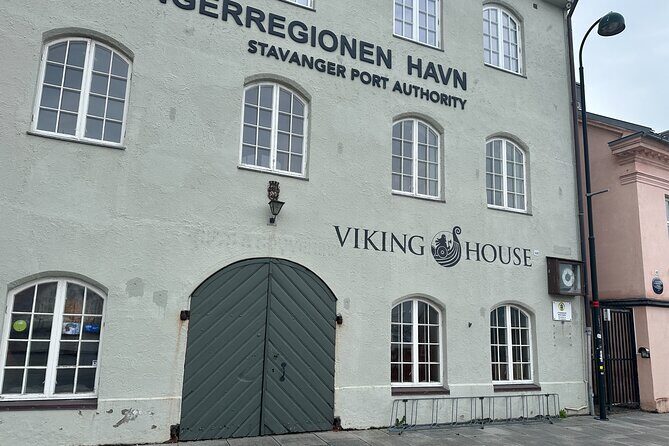
Next you’ll head to Sjøfartsmonumentet, where the audio spotlights the harbor view and the sailors statue. This stop is about continuity. Stavanger’s seafaring identity didn’t start in one era—it runs from Viking connections through later sailing culture and into modern life.
I like this stop because it gives you a bridge. If you only focus on old buildings, you might miss the real engine behind Stavanger’s growth. The harbor-centered story helps you connect:
- monuments you see in passing,
- the city’s maritime past,
- and why the sea keeps showing up in local memory.
Photo tip: treat the harbor views as your “reset button.” Take a moment, frame the statue and the water, then let the audio explain what you’re seeing.
Stop 3: The Alexander Kielland statue and why names matter
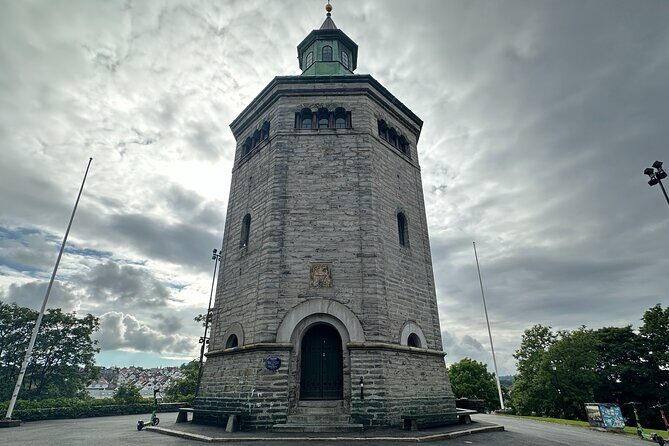
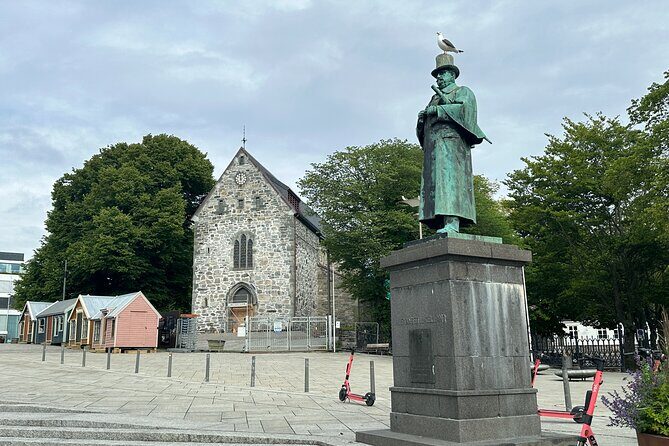
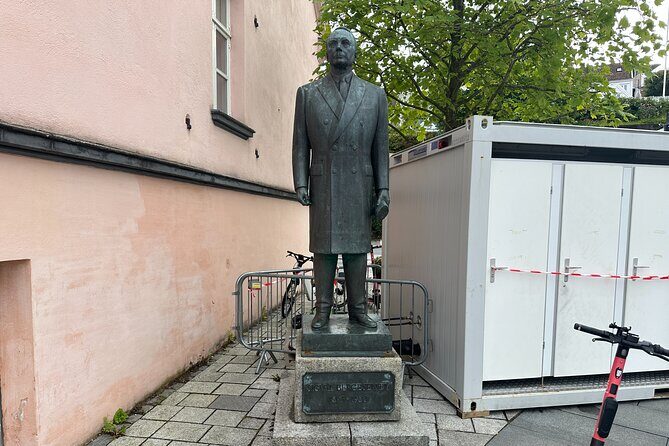
After that, you’ll encounter the Statue of Alexander Kielland. The tour approach here is practical: the audio helps you understand who he was, what he did, and why he’s important enough to be memorialized.
Statues can be confusing when you don’t know the figure. Here, the narration gives you just enough background to make the monument feel meaningful instead of random.
Why this stop works: it trains your eye for the city’s “memory system.” Stavanger didn’t only preserve buildings—it also preserved people in stone.
Consideration: if you like longer museum-style storytelling, the 10-minute segment might feel short. But that’s also part of the tour’s efficiency.
You can also read our reviews of more historical tours in Stavanger

The oldest church in Norway: standing outside and hearing what made it matter
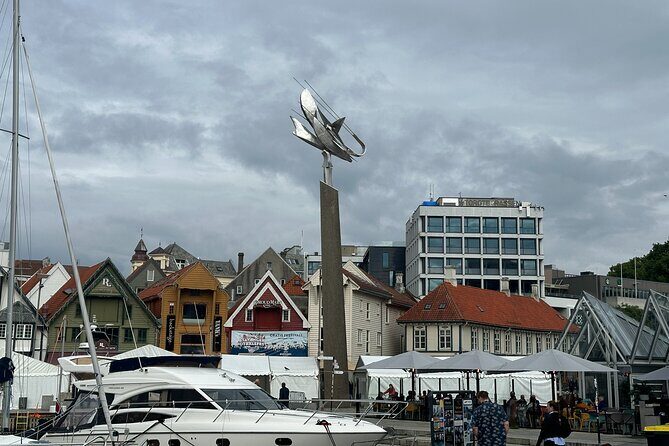
From there, you’ll reach a stop described as the oldest church in Norway, with the tour played while you stand outside. The experience emphasizes the story and history rather than ticketed entry.
This is a good time to slow slightly. Churches often have details you can miss while you’re hurrying. Even without going inside, standing still for a few minutes lets the narrative connect architecture, time, and local identity.
What to expect: outdoor viewing, short commentary, and a focus on story—more “why it exists” than “how to get in.”
Small drawback: because it’s outside-only here, you won’t get interior features or guided access that you might find with a ticketed church visit.
Canning big business: the museum-facing story you hear from the street
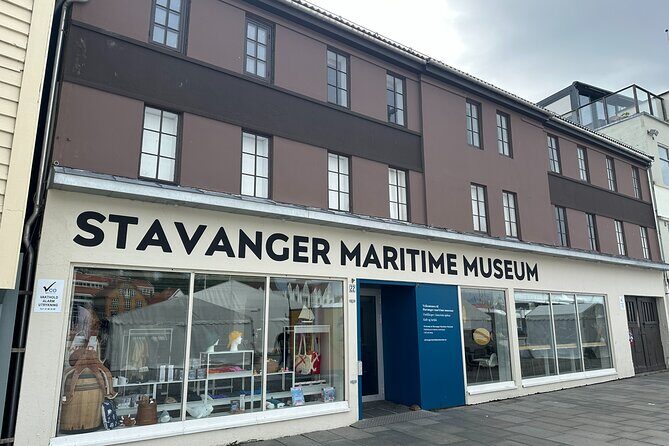
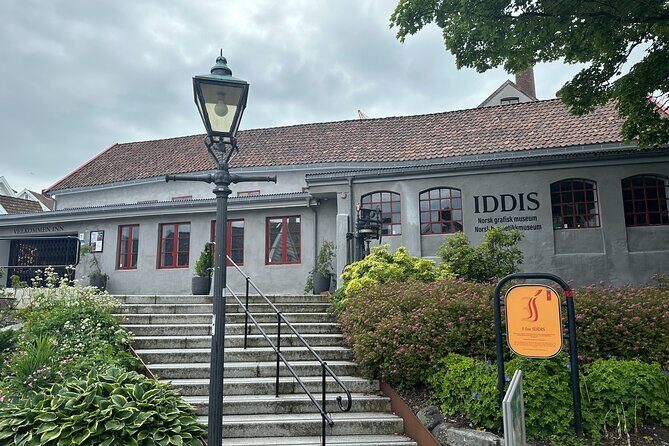
The next chapter shifts to work and industry. You’ll stop outside a canning-related museum area, where the narration explains how canning became big business and helped shape Stavanger’s economy and employment.
This is one of the most valuable segments because it moves past romantic “old town” imagery. It asks a real question: how did people pay rent, buy food, and build stability?
Why it matters for your understanding of Stavanger: it explains the city’s workforce and growth patterns. In other words, it’s not just a scenic walk—it’s a city-systems walk.
If you’re the type who likes understanding how a place functioned, you’ll probably find this section hits harder than you expect.
The old fire town on a height: stories from above
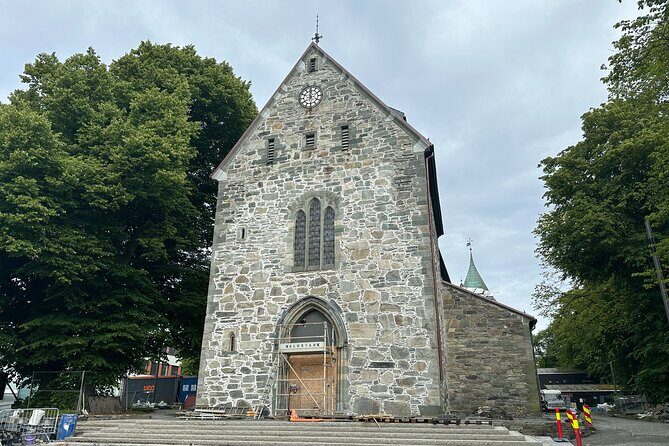
Then you’ll make your way to the old fire town, described as standing high above the town. This stop is built around the idea of risk, response, and how communities adapted.
Even without extra context, “fire town” imagery tells you the city learned lessons the hard way. The audio gives you those connections and local stories while you’re still in public space—so you can read the location and understand why it’s positioned where it is.
Tip: if you’re taking photos, this is a good place to pause. Elevated views are naturally easier to frame, and the audio gives you a reason to look instead of just snapping and moving.
Stop 4: Fargegaten, the color street, and a practical food hint
Fargegaten is the kind of place you can see instantly and remember for a long time. Here the tour calls it the color street, and the audio explains how it started and why there are so many colors.
But what I especially appreciate is that the narration includes guidance on where to eat well. It’s not a random restaurant list—it’s tied into the neighborhood story, so it feels like part of the experience rather than a plug.
What you’ll do here: walk the street, let the audio explain the color logic, then decide if you want to stop for a meal afterward.
Possible drawback: Fargegaten is popular. If it’s crowded, you may feel a bit squeezed while trying to take pictures and listen at the same time. A good workaround is to take slower steps and let the audio run while you stand aside for a minute.
Stop 5: Geoparken and the oil story near the Petroleum Museum
The tour ends at Geoparken, located just outside the Petroleum Museum area. This is where Stavanger’s modern identity clicks into place.
The narration shows you parts of the oil industry and explains the history of oil in Norway—tying back to what you learned earlier about work, shipping, and the city’s long relationship with the sea.
If you’re coming to Stavanger specifically to understand the “why” behind the city, don’t rush this last section. The audio here gives you a framework so that if you later step into the Petroleum Museum, you’ll already know what threads to follow.
And you’ll end at a location with easy continuation options. The tour notes it’s close to famous shops and parks—so you’re not left stranded at a quiet corner.
Stop 6: Einar Hedéns Plass for a slower wrap-up
Before you finish, there’s a stop at Einar Hedéns Plass, a peaceful park-like space. The audio shares the story of how the area was saved, and it includes Viking and historical references.
I like this kind of ending because it gives your brain a quiet landing. After monument density and street stories, you get a moment to reset. It’s also a reminder that preservation is active work—people made choices to protect areas, not just admire them later.
Price and value: why $9.75 can work better than a guided tour
At $9.75 per person, this sits in the “very reasonable” category—especially for a tour that covers multiple stops with GPS-based audio. Guided tours in Europe can easily cost several times that once you factor in group logistics.
Here’s the value equation I see:
- You pay less, but you still get structured storytelling.
- You avoid waiting for a guide and can control timing.
- The tour can be reused: you can go anytime (within the timeframe) and listen again.
It’s also a smart choice if you don’t want to commit to a single fixed schedule. Even if you start late or your day changes, the structure stays with you.
The tradeoff is what you’d expect: there’s no live Q&A. If you love asking follow-ups and getting personal recommendations in real time, you might prefer a guided option. But for getting the main stories straight while walking, this price is hard to beat.
Timing: how long it takes and how to pace it without rushing
The experience runs roughly 1 hour to 1 hour 30 minutes. On a practical level, that means you can fit it into:
- a morning or afternoon sightseeing block,
- a cruise-day window (with some margin for city walking),
- or an evening stroll if the weather is kind.
A good pacing strategy:
- Start calmly and let the first stop set your rhythm.
- Don’t spend too long trying to “perfect” every photo early—save time buffers for Fargegaten and the end area.
- Near Geoparken and the Petroleum Museum region, slow down so the oil story lands.
The tour’s design supports stop-and-go. You don’t have to finish in one go; you can pause and return within your day.
Who should book this Stavanger GPS tour (and who might want a different style)
I think this tour fits best if you:
- want English audio and a simple way to connect the dots across multiple historic areas,
- like walking at your own speed,
- are happy learning through short street-level chapters,
- and prefer spending money on meals and transport, not on a pricey guided format.
It may be less ideal if you:
- want detailed indoor access at every stop (this is described as all outside),
- dislike relying on phone prompts while walking,
- or strongly prefer live human explanations.
If you fall somewhere in the middle, you’re probably still a good match—because the stops are short, and the audio is built for motion.
Should you book? My take
If you’re visiting Stavanger and want a clean, affordable way to understand what you’re seeing—Gamle Stavanger, the harbor stories, color street Fargegaten, and the oil-era ending—this GPS audio walk is an easy “yes.” The price is low enough that you can treat it as a smart orientation tool, not a major commitment.
I’d especially recommend it if you’re juggling time (like a cruise stop) or you just don’t want to herd yourself into a fixed-group tour.
Book it if you enjoy walking with guidance. Skip it if you want lots of indoor tickets and a guide you can pepper with questions.
FAQ
FAQ
How long is the Stavanger Historic Sites smartphone audio walk?
It takes about 1 hour to 1 hour 30 minutes, depending on how long you pause at each stop.
What does the tour cost?
The price is $9.75 per person.
Is the tour offered in English?
Yes, it’s offered in English.
Is this a guided tour with an in-person guide?
No. It’s a self-guided walking tour using the app. There’s no in-person guide.
Where does the tour start and end?
It starts at Villa Blidensol, Øvre Strandgate 112, 4005 Stavanger, and ends at the Norwegian Petroleum Museum, Kjeringholmen 1a, 4006 Stavanger (Geoparken area).
Are any meals or drinks included?
No. The tour does not include food or drinks.
Is admission included to the sites?
The experience notes that there’s no admission included. The key stops described are free to view, since the tour is all outside.
Does the tour expire after you buy it?
No. The tour never expires, and you can listen again anytime after you complete it.
What stops are included on the route?
You’ll hear about Gamle Stavanger, Sjøfartsmonumentet, the Statue of Alexander Kielland, an oldest-church stop, a canning business museum area stop, an old fire town viewpoint, Fargegaten, Geoparken near the Petroleum Museum, and Einar Hedéns Plass.
What’s the cancellation policy?
You can cancel for a full refund if you cancel at least 24 hours before the experience’s start time. Free cancellation applies under that timing rule.