REVIEW · BERGEN
The influence of Bergen in Norway’s development, city tour
Book on Viator →Operated by Bergen tours · Bookable on Viator
Bergen makes sense in two hours. This walking tour gives you a clear line from Den Nationale Scene to UNESCO Bryggen, using the city’s key places to explain how Bergen grew into a cultural and trading center. I love that it turns landmarks into a story, not a checklist. I also like the pace—short stops that help you map the city fast.
A great guide makes a huge difference here, and the experience stands out for friendly, on-time guidance. In the past, the guide Omar has been described as discreet, efficient, and ready to help you understand what you’re looking at. You’ll also get a practical mobile ticket, and the tour runs in English.
One possible drawback: at Haakon’s Hall, the tour includes entry to the fortress area, but the palace/tower museum parts are not included—those have a separate fee of about €17 for both museums. If you want to spend extra time inside, plan for that add-on.
In This Review
- Key highlights I’d plan around
- A two-hour Bergen primer that connects culture and trade
- Starting at Den Nationale Scene: culture as a city signal
- Torgallmenningen: finding Bergen’s center and its rhythm
- The Fish Market: a tradition with more than 7 centuries behind it
- Bryggen Hanseatic Wharf: UNESCO with an angle on real work
- Haakon’s Hall and Bymuseet: royal power and the Viking-to-Christian shift
- Price and value: what $45.66 buys you in real terms
- Timing, group size, and why the pace feels good
- Where you start and where you finish (so you don’t waste time)
- Who should book this tour, and who might want a different option
- Should you book this Bergen city tour?
- FAQ
- How long is the Bergen city tour?
- What is the price per person?
- What language is the tour offered in?
- Do I need a paper ticket?
- Where does the tour start and end?
- Is entry to the Haakon’s Hall museums included?
- How big is the group?
- Can I cancel for a full refund?
Key highlights I’d plan around
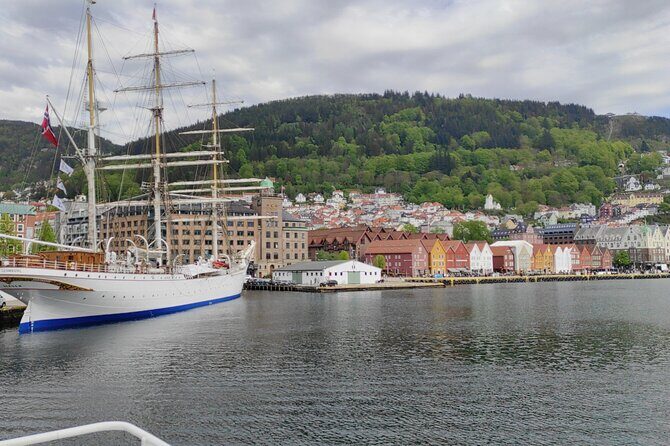
- A fast, story-led Bergen orientation that helps you understand where the city’s identity came from.
- Den Nationale Scene from the outside, with the socio-cultural message explained, no long detour required.
- Fish Market with centuries behind it, tied directly to Bergen’s long tradition.
- Bryggen explained through work and trade, not just its UNESCO status.
- Haakon’s Hall with the Viking-to-Christian shift, plus optional museum visits for extra depth.
A two-hour Bergen primer that connects culture and trade
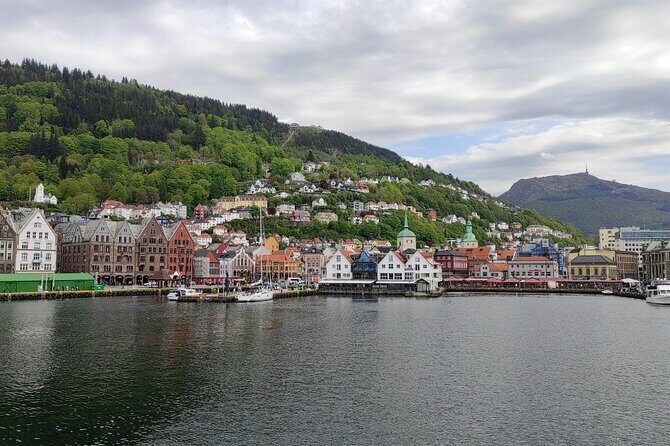
This is the kind of tour you take when you only have a short window and you want your second day to be easier. In about two hours, you move through Bergen’s most important “anchors”: a major theater tied to social change, the city’s central square, the fish market with deep roots, the Hanseatic wharf, and the fortress linked to Norway’s royal past.
What makes it work is the angle. Instead of treating each stop as a separate photo opportunity, the guide connects them into one theme: Bergen’s development through public culture and everyday economic life. You walk away with a mental map plus a simple explanation for why certain areas matter.
You can also read our reviews of more city tours in Bergen

Starting at Den Nationale Scene: culture as a city signal
You begin at Den Nationale Scene at Engen 1. The emphasis is on seeing the building from the outside and understanding why its existence mattered to society at the time. The idea isn’t a long museum-style visit; you’re there long enough to get context and then move on.
This format is a plus if you’re short on time. A theater can sound like an odd first stop, but the point is smart: it shows how Bergen wasn’t just growing physically—it was also shaping its cultural voice. If you like learning how cities brand themselves through big public projects, you’ll appreciate this start.
The one thing to know: you won’t be spending 25 minutes inside. The time is used for explanation plus walking to the next viewpoint.
Torgallmenningen: finding Bergen’s center and its rhythm
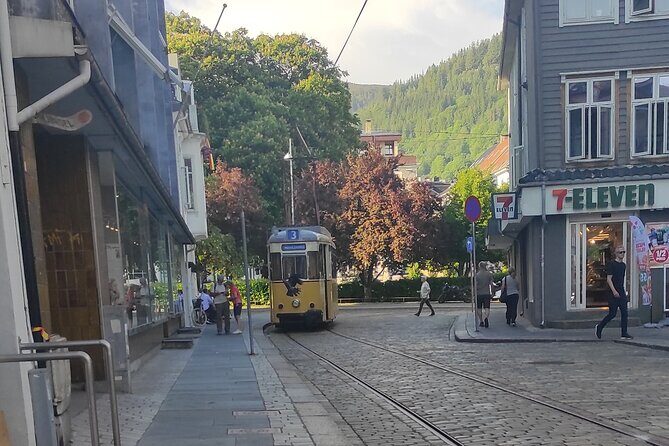
From Den Nationale Scene, you head to Torgallmenningen, Bergen’s central square. This stop is about orientation. From here, you get a better sense of how the city is laid out and how the different areas relate to each other.
I like this kind of pause because it helps you avoid the common first-day problem: you see great places but don’t yet know how they connect. Once you’ve stood in the center, the rest of the walk makes more sense. It also makes it easier to plan your future wandering, since you’ll recognize where you are relative to the action.
You’re not stuck here long—about 20 minutes—so it works as a quick reset.
The Fish Market: a tradition with more than 7 centuries behind it
Next up is the Fish Market, one of Bergen’s signature traditions with more than 7 centuries of history. Here, the focus is on the market as part of the city’s identity, not just as an attraction.
If you’re the type who likes to understand how ordinary work shapes a place, this stop pays off. Fish markets are often where you see the city’s daily culture in real time: what people trade, how the waterfront life operates, and why a certain kind of commerce sticks around for generations. Even if you don’t shop, you’ll get the bigger meaning.
The time is again around 20 minutes, which is ideal for keeping the tour moving while still giving you enough context to recognize why this spot matters.
Bryggen Hanseatic Wharf: UNESCO with an angle on real work
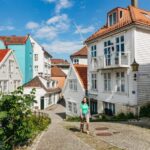
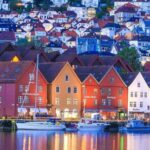
Bryggen Hanseatic Wharf is next, and it’s where the tour really sharpens its theme. This area is UNESCO-protected, and the explanation focuses on businesses that operated here for centuries—especially involving fishermen from across Scandinavia and the merchants who lived and worked there.
I like that the tour doesn’t reduce Bryggen to a postcard. You learn how trade worked as a system: who came, what kind of work was supported, and what daily life looked like for the merchants tied to that economy. That context changes how you experience the place afterward. You start noticing details as part of a working waterfront history, not just a set of old buildings.
Plan on about 30 minutes here. It’s the longer stop of the walk, and it’s also the one where having the right explanation helps the most.




Haakon’s Hall and Bymuseet: royal power and the Viking-to-Christian shift
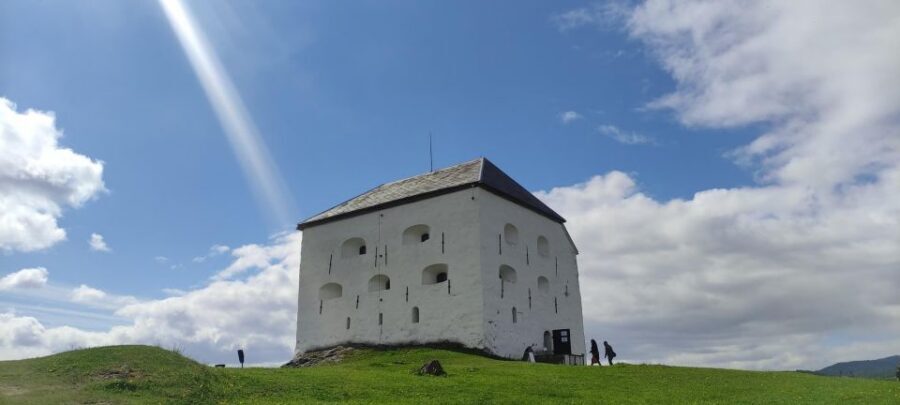
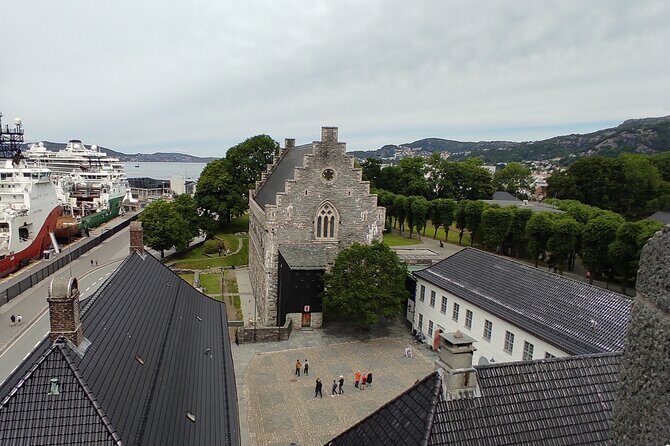
The final stop is Haakon’s Hall – Bymuseet i Bergen, the fortress/residence associated with Nordic kings. The tour frames it as part of the evolution from Viking culture to Christianity, and it describes Haakon’s Hall as one of Bergen’s more enigmatic medieval structures.
This is also where you get a more physical sense of the site. The tour includes entering the fortress and hearing why the place matters. Just don’t expect the full museum experience to be automatic: entry to the palace or the tower isn’t included. If you want those museum interiors, there’s an additional fee of about €17 for both museums.
For me, that’s a fair setup. You get the key overview in the time you paid for, then you decide if you want to spend extra money and time to go deeper. If you only want the core story, you can finish the tour and keep exploring on your own.
Price and value: what $45.66 buys you in real terms
At $45.66 per person for roughly 2 hours, this is priced like a focused guided orientation. The tour includes a professional guide, and the stops themselves are structured so that admission for what’s covered at each point is free.
What you’re really paying for is the thinking. In a city like Bergen, it’s easy to walk past important places and not know why they mattered. Here, the guide’s job is to give you the “why” quickly: culture shaping society, market tradition, trading networks, and royal/faith transitions.
The separate Haakon’s Hall museum fee is the main cost consideration. But since that cost is optional for going inside specific parts, you can match your spending to your interests. If you’d rather just get oriented and save money for later, you can do that. If museums are your thing, budget the extra €17.
Timing, group size, and why the pace feels good
The tour runs about 2 hours total and is booked fairly often—on average about 20 days in advance. It also has a maximum group size of 200 travelers. That doesn’t mean it’ll feel chaotic all the time, but it does mean you should expect a “walk-and-listen” style rather than one-on-one attention.
Most of the stops are about 20 minutes, with 30 minutes at Bryggen and Haakon’s Hall. That rhythm is part of the value. You don’t get trapped in long explanations, and you still leave each stop with a takeaway you can use immediately.
The tour is offered in English, and confirmation is sent at booking. You’ll also have a mobile ticket, which keeps things simple when you’re moving through town.
Where you start and where you finish (so you don’t waste time)
You meet at Den Nationale Scene (National Stage), Engen 1, 5803 Bergen. The tour ends at Håkonshallen – Bymuseet i Bergen, Bergenhus 10, 5003.
If your arrival plan involves starting at the port of Jekteviken, the end point still lands at the Bergen Fortress area. The key practical point: you’re finishing near where the historic core sits, which is handy if you want to continue exploring nearby without backtracking.
Who should book this tour, and who might want a different option
This one is a strong fit if you:
- Want a quick first-day map of Bergen’s most meaningful areas
- Like learning how history connects to everyday places like squares and markets
- Prefer an English guide who keeps things organized and moving
It might be less ideal if you:
- Want deep museum time on your first stop at Haakon’s Hall (you’ll likely pay extra)
- Are hoping for long inside access at every stop (many parts are mainly about viewing and explanation)
If you’re the type who returns to a place later, this tour works well as your “set the stage” morning or early afternoon. You’ll know what to prioritize once you’ve got the bigger picture.
Should you book this Bergen city tour?
I’d book it if you want an efficient Bergen introduction that links culture, trade, and power into one walking story. At $45.66 for about two hours with a professional English guide, it’s good value for getting your bearings and understanding why certain spots matter.
I’d hesitate only if you’re already confident navigating the center and you’re mainly chasing deep museum visits. Since Haakon’s Hall museum interiors cost extra (around €17 for both museums), people who want maximum indoor time may want a different plan. For everyone else, this is a smart way to make your first hours in Bergen feel purposeful.
FAQ
How long is the Bergen city tour?
It lasts about 2 hours.
What is the price per person?
The tour costs $45.66 per person.
What language is the tour offered in?
The tour is offered in English.
Do I need a paper ticket?
No. You get a mobile ticket.
Where does the tour start and end?
It starts at Den Nationale Scene (National Stage), Engen 1, 5803 Bergen, and ends at Håkonshallen – Bymuseet i Bergen, Bergenhus 10, 5003 Bergen.
Is entry to the Haakon’s Hall museums included?
Entry to the palace or tower parts is not included. The entrance is about €17 for both museums.
How big is the group?
The tour has a maximum of 200 travelers.
Can I cancel for a full refund?
Yes, you can cancel up to 24 hours in advance for a full refund. If you cancel less than 24 hours before the start time, the amount paid won’t be refunded.