REVIEW · TRONDHEIM
Trondheim’s Inner Circle: A Self-Guided Audio Tour
Book on Viator →Operated by VoiceMap Audio Tours · Bookable on Viator
Trondheim’s core tells stories fast. This self-guided English audio tour uses VoiceMap to lead you through Viking-era beginnings, royal sites, and the city’s defining landmarks, all at your own pace. I like that once you download it, the tour never expires, so you can reuse it later when you want one more walk. I also like the straightforward route guidance that keeps you moving between sights. One possible drawback: if the app struggles to get a GPS fix near fences or you have trouble with the download steps, you may need a bit of patience to get started.
What you get for $7.99 is a well-paced loop (about 1 to 1.5 hours) that ends at Nidaros Cathedral. It is built for independent travelers who want history without a group meeting time. And yes, you’ll be doing real walking—so if you’re limited on distance or time, plan accordingly.
In This Review
- Key things to know before you go
- Why This Audio Walk Works So Well in Trondheim
- Price and Time: $7.99 for a 1–1.5 Hour City Loop
- Getting Set Up: VoiceMap, Offline Use, and the Start-Point Moment
- The Route Big Picture: 1,000 Years, Told in Walking Blocks
- Stop 1: The Viking Roots That Lead to Trondheim’s Christian Turn
- Stop 2: Munkegata and Stiftsgården, the Wooden Palace That Dominates the Mind
- Stop 3: 1681 Fire, Baroque Reconstruction, and the Old Town Bridge
- Stop 4: Kristiansten Fortress, the Hilltop View and the WWII Story
- Stop 5: Archbishop’s Palace Grounds and the Walk to Nidaros Cathedral
- What I Think You’ll Like Most: the Most Praised Aspects
- Possible Tradeoffs (So You’re Not Surprised)
- Who Should Book This Audio Tour?
- Should You Book Trondheim’s Inner Circle?
- FAQ
- How long is the Trondheim Inner Circle audio tour?
- How much does the tour cost?
- Is the tour available in English?
- Do I need cell service during the walk?
- Can I use the tour more than once?
- Do I need a smartphone?
- Where does the tour start and where does it end?
- Is the tour available all day?
- Is transportation or food included?
- What if I need to cancel?
- FAQ
- Is this a group tour with strangers?
- Are service animals allowed?
- Is there a time limit or expiration after booking?
Key things to know before you go
- Lifetime access: once downloaded, your tour content does not expire
- Offline support: audio, maps, and geodata work without cell service
- Clear city arc: Viking founder stories to St. Olav and Gothic Trondheim
- Royal sights on foot: Stiftsgården and the Archbishop’s Palace grounds are part of the route
- Fortress stop included: Kristiansten’s WWII story and museum/dungeon access are noted
- GPS can nudge you: if you drift off route, the app can warn and redirect
Why This Audio Walk Works So Well in Trondheim
Trondheim is one of those cities where you can feel centuries in the street-level details. This tour takes that idea and turns it into an easy walking plan. You start near the Nidaros Cathedral area and move outward through wooden royal power, medieval churches, the riverfront warehouse look, and viewpoints on the hillside.
The best part is how the narration links places to turning points. You do not just get dates and names—you get the “why” behind why these buildings matter in Trondheim’s story. The route also keeps moving. You are not stuck reading one plaque for 45 minutes.
If you like doing your sightseeing in short bursts—one stop, one story, one view—this format fits well. You can slow down when the riverfront looks good, speed up when you want to get to the fortress, and replay sections later thanks to lifetime access.
You can also read our reviews of more guided tours in Trondheim


Price and Time: $7.99 for a 1–1.5 Hour City Loop
At $7.99 per person, the value comes from two things: time and reusability. You get around 1 hour to 1.5 hours of guided commentary without needing to pay for a ticketed guided group tour. The “never expires” detail matters more than it sounds. It means you can use this walk as a first introduction now, and then as a refresher later.
You should also think about what you might skip. If you were paying for multiple tours to cover “old town + royal areas + cathedral,” costs add up quickly. Here, one low price gets you through the main inner-core narrative, ending where you likely want to be anyway: Nidaros Cathedral.
The tradeoff is that it is not a long-day experience. It covers a concentrated slice of Trondheim rather than every corner. If you want a half-day or full-day plan, you might pair this with extra time around the cathedral precinct or the riverfront after your tour ends.
Getting Set Up: VoiceMap, Offline Use, and the Start-Point Moment
This tour uses the VoiceMap application. You bring your own smartphone (it is not included), and the tour provider builds in offline access so you can still hear the audio and use maps without relying on data.
Here is the practical setup approach that usually works best:
- Download the app and your tour content ahead of time so you are not fighting connectivity.
- Use the instructions you get at booking to redeem and download the tour.
- Plan to check your exact starting area before you press play.
Why I’m stressing the start point: the route begins at a specific location, and the narration expects you to begin there. In at least one real-world scenario, a festival setup made it hard to approach the start area closely, and the GPS distance display kept insisting you were slightly off. The workaround was using a force start prompt, and the audio then began. That tells you something important: if you feel like the app is being overly strict, do not panic—look for an option to force start or re-check the route on the map.
GPS drift can also happen. The app may tell you you are off the route and ask you to check your map and return to the route. If you know you are walking the right path but the device thinks otherwise, zooming out on the map view and matching the next route point helps.
The Route Big Picture: 1,000 Years, Told in Walking Blocks
The tour is structured like a story in chapters, each one tied to a site you can see. The arc goes roughly like this:
- Trondheim’s foundation and the Viking-to-Christian pivot
- The royal and social center around Munkegata and Stiftsgården
- The city’s rebuilding after the 1681 fire, plus the old waterfront feel
- Kristiansten Fortress on the hill with military and WWII context
- Final walk past the Archbishop’s Palace grounds to Nidaros Cathedral
Along the way, you get the kind of context that makes your own photos better. Instead of shooting another street corner, you know what happened there and why it changed.
Stop 1: The Viking Roots That Lead to Trondheim’s Christian Turn
The first part of the tour frames Trondheim as a place where Viking heritage and royal history intersect right in the street-level layout. You follow the “inner center” walking line as you move past historic wooden buildings, wharves along the riverfront, and sacred sites tied to more than 1,000 years of change.
Then the narration zooms in on Olav Tryggvason, king of Norway from 995 to 1000 AD, credited with founding Trondheim in 997. He is also known for building the first Christian church in Norway—an easy detail to remember because it links the city’s identity to the larger shift from saga-world myth to organized Christian institutions.
If you like when a walking tour gives you one or two anchor names early, Olav is a strong one. You’ll keep seeing his story reflected again later at Nidaros.
Stop 2: Munkegata and Stiftsgården, the Wooden Palace That Dominates the Mind
Next you head down Munkegata and into one of Trondheim’s most memorable sights: Stiftsgården. The tour highlights Stiftsgården as the largest wooden palace in Northern Europe and notes its role as the official royal residence since 1906.
You also get the building’s basics without it turning into an architecture lecture. Stiftsgården was built between 1774 and 1778 for Lady Cecilie Christine Schøller, widow of chamberlain Stie Tønsberg Schøller, a wealthy wholesaler and trader. The narration also connects her to the city’s social elite, so it is not just “a big building”—it becomes a clue about Trondheim’s power structure.
What I like about including Stiftsgården here: it sits in the middle of the route, so it works as a mental reset. After foundation stories, you now see the kind of wealth and status that shaped the city’s neighborhoods.
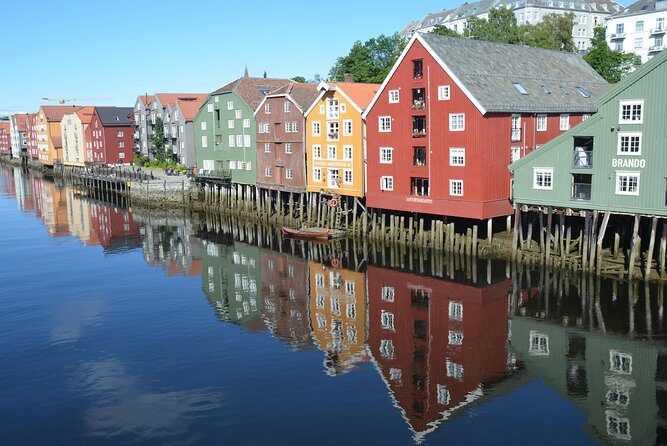
As you continue, the audio keeps your eyes busy with the smaller stuff too: narrow streets, parks, medieval churches, and the waterfront district with colorful warehouses that date back hundreds of years.
Stop 3: 1681 Fire, Baroque Reconstruction, and the Old Town Bridge
Trondheim’s history includes a big rupture: the devastating 1681 fire. This tour uses that event as a turning point to explain why you see the baroque reconstruction style in the city afterward. That matters because cities can look “old” in a general way, but fire-and-rebuild moments create very specific architectural layers.
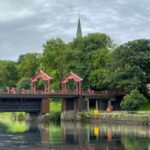
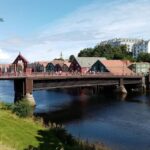
You also learn about the Old Town Bridge, known as the gate of happiness. Even if you never stop to read a sign, the phrase gives you something to remember while you walk—like a nickname for a place that’s woven into local identity.
From here, the route aims at that riverfront feel: the sense of Trondheim as a working city with wharves, warehouses, and older travel/commerce infrastructure. If you enjoy walking near water, this portion delivers. If you do not, keep your attention on the narration—so you still feel like you’re traveling through meaning, not just moving through space.
Stop 4: Kristiansten Fortress, the Hilltop View and the WWII Story
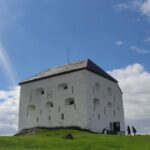
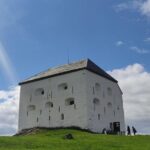
Kristiansten Fortress sits up on the hillside, so you feel the shift from street-level history to strategic oversight. The tour explains that after the 1681 fire, Kristiansten Fortress was built to watch the city and serve a military role. It also mentions that it helped save Trondheim from conquest by Sweden in 1718.
Then comes the harder chapter: during the Second World War, the fortress was taken over by Nazis, and 23 Norwegian patriots were executed inside it. The building is now a museum. The narration also notes that there is a dungeon that is open to view.
A smart practical detail: the audio tells you to watch for a flag waving over the fortress. If the flag is up, it means the fortress is open to the public. That is useful because you can plan your moment for museum time rather than guessing.
If you’re the kind of person who likes both views and context, Kristiansten gives you both. You get the skyline vantage and you understand why the hill mattered in different eras.
Stop 5: Archbishop’s Palace Grounds and the Walk to Nidaros Cathedral
As your tour nears the end, you move through the grounds of the Archbishop’s Palace and learn the site’s history while you walk. This is a quieter segment than the fortress, but it sets up the emotional endpoint well.
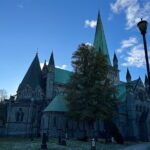
Then you reach Nidaros Cathedral, described in the tour as the northernmost Gothic cathedral in the world. The narration also ties the building to St. Olav, noting it was built over his tomb.
This last stretch is where the tour really pays off. A cathedral is easy to appreciate aesthetically, but it’s better when you understand what it represents. The audio’s focus on St. Olav connects the earlier Olav Tryggvason founder story to the place that anchors Trondheim’s Christian legacy in stone.
If you want to turn this into a longer outing, plan time after the tour ends for cathedral tickets and a slower wander inside. The audio tour itself is short, but it brings you to the exact right doorstep.
What I Think You’ll Like Most: the Most Praised Aspects
This experience earns its solid rating for a few reasons that matter on the ground:
The directions and pace are easy to follow. When the start point is found, the narration guides you in a way that lets you keep walking without constant phone checking.
The offline, lifetime approach is practical. You can download once, then carry the tour plan with you. That is great for Trondheim days when service can be unreliable or when you just hate draining your data.
The history length stays friendly. The commentary gives you just enough background to make the sites click, without swallowing your whole walk in textbooks.
Possible Tradeoffs (So You’re Not Surprised)
No tool is perfect, and there are a couple of things to consider before you commit your hour or so:
- Download and app setup can be a friction point. One unhappy experience centered on trouble downloading the tour and feeling the app was too complicated. The provider’s response indicated there are three simple steps to redeem and download. Still, if you know you get stressed with new apps, try the download earlier rather than waiting until day-of.
- Crowds, fences, and GPS strictness can block your start. If the start area is fenced off (for events or construction), the audio may not start even if you’re close enough for a human. In that case, you may need to use a force start option or adjust your position and try again.
- The GPS voice warnings can feel annoying. The app may repeatedly claim you’re off the route even when you believe you are on it. Treat it as a cue to check your map, not as an instruction to panic.
- It’s shorter than some people want. A couple of people wished for a bit more length. This is a focused loop, not a long guided day.
Who Should Book This Audio Tour?
This is a strong match if you:
- Travel independently and like controlling your own pace
- Want a compact, high-impact intro to Trondheim’s inner core
- Enjoy history told through real places—royal buildings, churches, riverfront areas, and a fortress with WWII context
- Prefer offline audio and reusable content
It may be less ideal if you:
- Hate app setup and troubleshooting
- Need fully hands-free navigation at all times
- Have very limited walking time and want more stops spread across a longer period
Should You Book Trondheim’s Inner Circle?
Yes—if you want an easy, low-cost way to understand Trondheim quickly and then keep exploring on your own. The $7.99 price is genuinely reasonable for what you get: offline audio + offline maps + lifetime access, plus a route that ties Viking-era origins, royal sites, the 1681 fire, Kristiansten’s hilltop role, and Nidaros Cathedral into one coherent walk.
My advice: download it the day before, and give yourself a few minutes at the start to confirm your exact location. Once it’s working, this tour is the kind of thing that makes you look at streets and buildings differently.
FAQ
How long is the Trondheim Inner Circle audio tour?
It takes about 1 hour to 1 hour 30 minutes.
How much does the tour cost?
The price is $7.99 per person.
Is the tour available in English?
Yes, the audio tour is offered in English.
Do I need cell service during the walk?
No. The tour includes offline access to audio, maps, and geodata through the VoiceMap app.
Can I use the tour more than once?
Yes. The tour comes with lifetime access, and once downloaded, the tour never expires.
Do I need a smartphone?
Yes. A smartphone is not included, but you need it to run the VoiceMap application.
Where does the tour start and where does it end?
It starts in Trondheim, Norway and ends at Nidaros Cathedral. The listed start/end meeting location includes Kongsgårdsgata 2, 7013 Trondheim, Norway.
Is the tour available all day?
The listed opening hours show it is available daily from 12:00 AM to 11:59 PM.
Is transportation or food included?
No. Transportation and food/drink are not included.
What if I need to cancel?
Free cancellation is available up to 24 hours in advance for a full refund. If you cancel within 24 hours of the experience start time, the amount paid is not refunded.
FAQ
Is this a group tour with strangers?
No. It is private, so only your group participates.
Are service animals allowed?
Yes. Service animals are allowed.
Is there a time limit or expiration after booking?
Not in the way you might expect. Once downloaded, the tour never expires thanks to lifetime access.